
Solitaire (Patience): overview, rules, common variants and digital play
Encyclopedic overview of solitaire (patience): objectives, common variants (Klondike, FreeCell, Spider, Pyramid, Golf), play areas, strategy, history and digital adaptations.
Solitaire (also called patience in some regions) is the general name for a family of single-player card games typically played with one or more packs of playing cards. While rules differ between variants, the usual aim is to rearrange cards according to suit and rank so that they form ordered stacks or are otherwise removed from play. Different versions test aspects of skill, planning and luck.
Image gallery
4 Images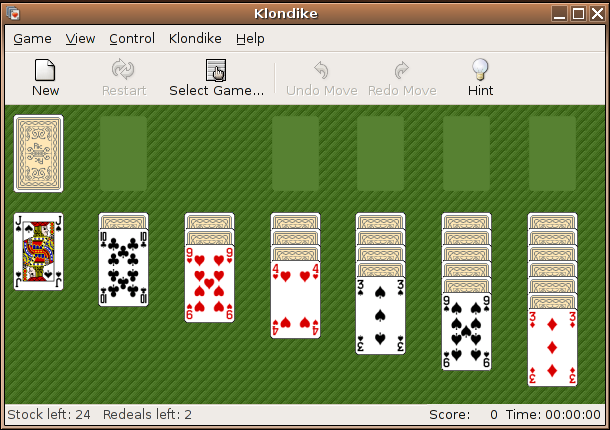

Key components and objective
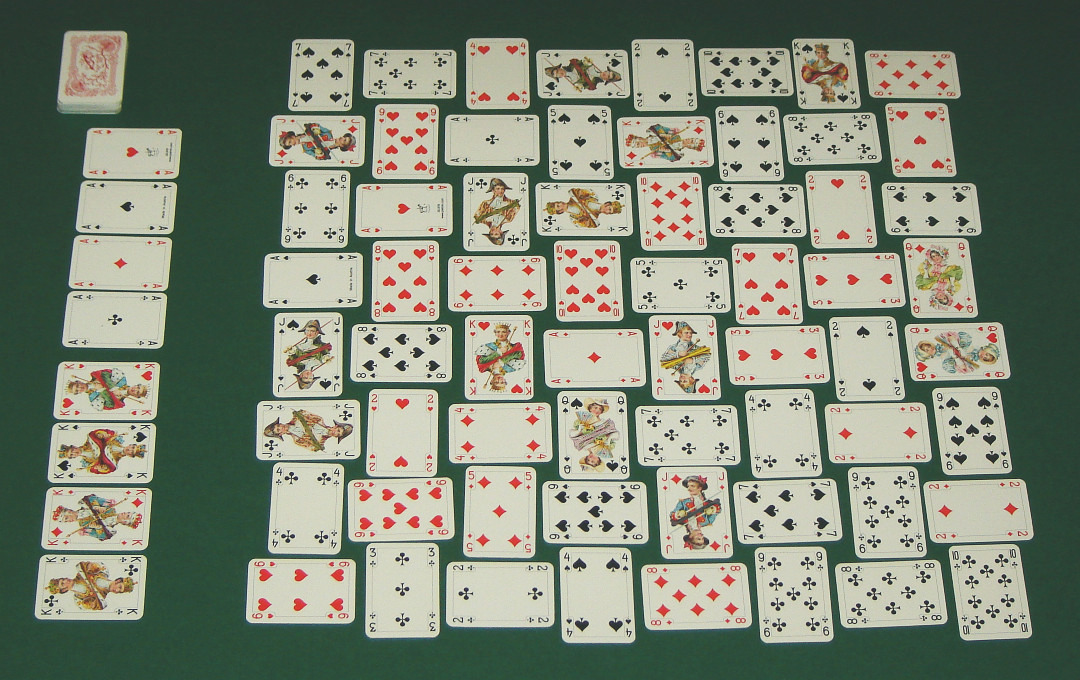
Many solitaire games use common play areas: a tableau (columns or piles where most play occurs), one or more foundations (where completed sequences are built, often from Ace upward), and a stock/waste for undealt cards. Some variants add free cells or a reserve to temporarily hold cards. The precise objective — for example building foundations by suit, clearing the tableau, or removing paired cards — depends on the variant.
Rules and common play areas
Tableau rules control which cards may be moved and whether entire piles or only single cards can be transferred. The stock supplies additional cards when play on the tableau is stalled. Foundations are usually built in ascending order by rank; in other games players assemble descending sequences on the tableau. Variants may allow redeals, limit the number of passes through the stock, or permit different stacking conventions.
Main variants
- Klondike – the classic form familiar from many computer implementations; cards are dealt to a tableau with alternating-color stacking and foundations are built by suit.
- FreeCell – all cards are dealt face-up and a small number of free cells permit temporary storage; play is highly skill-dependent and many deals are solvable with careful planning.
- Spider – often played with two decks; the aim is to build entire sequences of one suit which are then removed from the table.
- Pyramid – cards are arranged in a pyramidal layout and pairs that meet a target sum (commonly 13) are removed to clear the pyramid.
- Golf – the goal is to clear tableau columns by moving cards to a single foundation pile according to simple rank rules; scoring varies by rule set.
Strategy and solvability
Successful play often requires forward planning, careful use of temporary holding areas and attention to which cards are exposed. Some variants are largely skill-based, while others depend more on the initial deal. Players and researchers study solvability — whether a particular deal can be completed under the rules — and for some named variants large proportions of deals are known to be solvable, though unsolvable layouts also occur.
History, names and digital adaptation
Patience and solitaire have documented histories in Europe from the 18th and 19th centuries and evolved into many named variants. The games are commonly called "patience" in many countries, and specifically in the UK. In the late 20th century simple digital implementations were bundled with popular desktop operating systems and ported to handheld devices and computer apps, which helped popularize particular rule sets and introduce the games to wide audiences.
Terminology and further reading
When discussing solitaire it is usual to name the variant (for example Klondike, FreeCell or Spider) and to describe layout elements such as tableau, foundations, stock, waste and reserve. For basic background on the medium and related games see references on playing cards and general materials about the single-player card game family. Rulesets vary; for precise play consult the documentation for the chosen variant or a reliable rule compendium.
Author
AlegsaOnline.com Solitaire (Patience): overview, rules, common variants and digital play Leandro Alegsa
URL: https://en.alegsaonline.com/art/91685