
Sodium phosphate — salts, properties, uses and safety
Overview of sodium phosphate salts, common forms (mono-, di-, tri-sodium), chemical behavior, applications in food, industry and medicine, and environmental and health considerations.
Sodium phosphate refers to a family of inorganic salts derived from phosphoric acid. In these compounds, the phosphate anion can carry one to three sodium cations depending on how many acidic hydrogens remain. The group includes mono‑, di‑ and tri‑sodium salts, each with distinct chemical behavior, solubility and uses. For background on the parent acid and its protonation states see phosphoric acid and the related phosphate ion.
Image gallery
4 Images


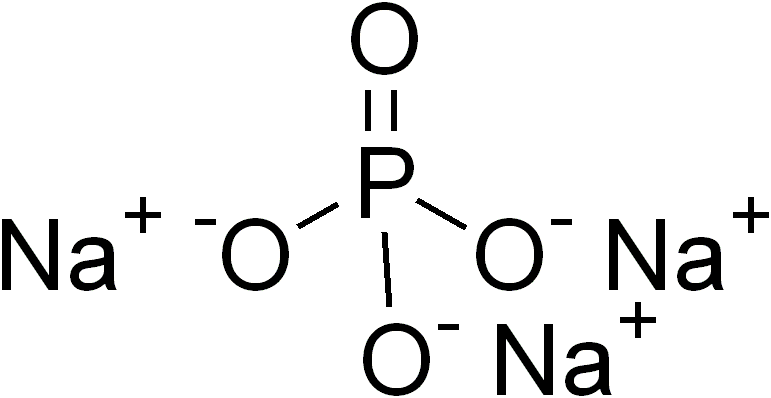
Common forms and basic chemistry
The three principal sodium phosphate salts are often named to indicate their hydrogen content: monosodium phosphate (NaH2PO4), disodium phosphate (Na2HPO4) and trisodium phosphate (Na3PO4). Monosodium phosphate retains two acidic hydrogens, disodium phosphate retains one, and trisodium phosphate contains no acidic hydrogens. These differences change the salts' pH in solution, their ability to act as buffers, and their compatibility with other chemicals.
Properties and buffering behavior
Sodium phosphates are generally white, water‑soluble solids. In aqueous solution they participate in the phosphoric acid–phosphate equilibria, which gives rise to useful buffering ranges near neutral pH. Mixtures of the mono‑ and disodium salts are commonly used to create phosphate buffer solutions with a controlled pH. Solubility and alkalinity increase from the mono‑ to the tri‑sodium salt.
Uses and applications
- Food industry: certain sodium phosphates act as emulsifiers, moisture retainers and leavening agents; they are regulated as food additives in many countries.
- Cleaning and maintenance: trisodium phosphate has been used as a heavy‑duty cleaner, degreaser and paint‑preparation agent.
- Medicine: sodium phosphate preparations serve as osmotic laxatives and bowel‑cleansing agents prior to endoscopy or surgery; they are used under medical guidance.
- Industrial: phosphate salts are used in water treatment, metal finishing, and as components in some detergents and corrosion inhibitors.
Safety and environmental considerations
When used appropriately, sodium phosphates are effective and generally safe, but overuse or inappropriate exposure can pose risks. In medical contexts they can disrupt electrolyte balance and are contraindicated for people with certain kidney or cardiovascular conditions. Environmentally, excess phosphate release to waterways can contribute to nutrient pollution and algal blooms, which is why many wastewater and agricultural practices aim to limit phosphate runoff.
Distinctions and notable facts
Although the term "sodium phosphate" is often used loosely, different salts are chosen for specific roles: monosodium and disodium salts are common in buffering and food applications, while trisodium phosphate is noted for its strong alkaline cleaning action. Their reversible protonation chemistry makes phosphate salts among the most versatile inorganic buffers in biological and industrial chemistry.
Questions and answers
Q: What is sodium phosphate?
A: Sodium phosphate is a group of chemical compounds that consist of a phosphate atom that can hold three other atoms.
Q: How many different forms of sodium phosphate are there?
A: There are four different forms of sodium phosphate that can be created, each with different combinations of hydrogen and sodium atoms.
Q: What is phosphoric acid?
A: Phosphoric acid is a type of sodium phosphate that contains three hydrogen atoms.
Q: What is sodium dihydrogen phosphate?
A: Sodium dihydrogen phosphate is a type of sodium phosphate that contains two hydrogen atoms and one sodium atom.
Q: What is disodium hydrogen phosphate?
A: Disodium hydrogen phosphate is a type of sodium phosphate that contains one hydrogen atom and two sodium atoms.
Q: What is trisodium phosphate?
A: Trisodium phosphate is a type of sodium phosphate that contains three sodium atoms.
Q: What is the purpose of sodium phosphate in different applications?
A: Sodium phosphate can be used as a food additive, a cleaning agent, a water softener, a fertilizer, and in some pharmaceuticals.
Related articles
Author
AlegsaOnline.com Sodium phosphate — salts, properties, uses and safety Leandro Alegsa
URL: https://en.alegsaonline.com/art/91538