
Smoke (1995 film)
Smoke is a 1995 American independent drama by Wayne Wang, written by Paul Auster, that links short character scenes around a Brooklyn tobacconist to explore storytelling and daily ritual.
Smoke is a 1995 American independent film directed by Wayne Wang from a screenplay by novelist Paul Auster. Set mainly around a small Brooklyn tobacconist, the film foregrounds ordinary interactions and the habits that shape everyday life. It is noted for its ensemble cast, quiet humor, and the recurring visual motif of the shopkeeper taking the same photograph of the storefront each morning, a ritual that becomes a means of reflecting on time and memory.
Image gallery
2 Images
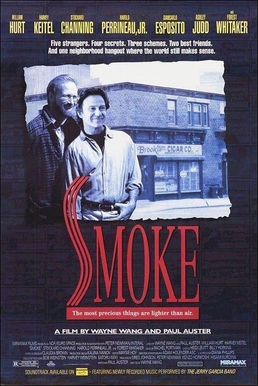
Overview
The narrative does not follow a single, conventional plot but assembles a mosaic of linked scenes and conversations. Through brief episodes that center on the shop and its regulars, the film explores chance encounters, personal histories and the ways people use storytelling to make sense of their lives. The tone balances melancholy and warmth, privileging character moments over plot mechanics.
Cast and characters
The film relies on an ensemble performance to give its vignettes weight. Prominent performers include Harvey Keitel and William Hurt, supported by actors such as Forest Whitaker and Stockard Channing. Each principal character brings a distinct perspective to the communal space of the shop, allowing the film to shift viewpoint and reveal how shared events look different from different vantage points.
Production and release
Produced by Hisami Kuroiwa with Harvey and Bob Weinstein, the film was shot on location in New York and released in 1995 within the era of 1990s American independent cinema. The production emphasized naturalistic dialogue and modest sets to maintain intimacy. For production background and distribution information see production notes. Direction and visual choices foreground everyday detail rather than spectacle; for information on the director see Wayne Wang.
Themes, reception and related work
Critics often highlighted the film's literary sensibility, a result of Auster's script and its interest in storytelling as a social act; more on the writer's involvement can be found at Paul Auster. The film received positive critical response for its performances and humane, low-key approach. In the same year the filmmakers and many of the same cast returned for a looser, improvisational companion project that explored similar characters and settings, underscoring the film's influence on small-scale, character-driven work in the period.
Legacy
- Often cited as a representative example of 1990s character-driven independent cinema.
- Known for its focus on ritual, small details and storytelling as a communal practice.
- Its companion project and the photographic motif remain notable elements in discussions of the film.
Related articles
Author
AlegsaOnline.com Smoke (1995 film) Leandro Alegsa
URL: https://en.alegsaonline.com/art/91254