
So Dear to My Heart (Disney film)
A 1948 Walt Disney production blending live action and animated sequences, based on Sterling North's Midnight and Jeremiah; a nostalgic rural coming-of-age story released to U.S. audiences in 1949.
Overview
So Dear to My Heart is a feature film produced by Walt Disney that mixes live-action storytelling with animated sequences. Created in 1948 and issued to the wider United States market in January 1949, the picture adapts material from Sterling North's book Midnight and Jeremiah. It belongs to the period when the studio explored hybrid formats and nostalgic Americana themes.
Image gallery
1 Image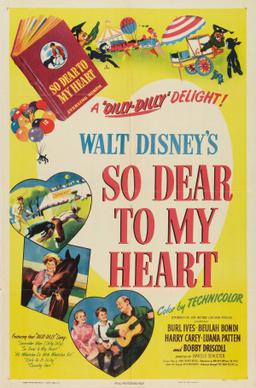
Style and structure
The film combines filmed performances and settings with interludes of hand-drawn animation that illustrate characters' imaginations, memories, or moral lessons. This hybrid approach was used by the studio to bridge family-friendly realism and fanciful interpretation: the live-action scenes ground the story in a rural, historical setting, while animated passages provide lyrical or allegorical commentary.
Themes and source
Adapted from Sterling North's short work, the narrative centers on rural childhood, personal responsibility, and the bonds between a young protagonist and the animals or neighbors around him. Songs and folk-inspired music often accompany scenes, reinforcing the film's pastoral mood and evoking early 20th-century Midwestern life.
Reception and legacy
At release the film appealed to audiences seeking wholesome, family-oriented entertainment. Critics and historians have since described it as a nostalgic entry in the studio's catalog — less prominent than major animated features but notable for its attempt to meld realistic period drama with animated fantasy. Its combination of techniques illustrated the studio's versatility in the years after World War II.
Notable aspects
- Based on a literary source by Sterling North, giving the film a rooted narrative foundation.
- Uses both live-action drama and animation sequences to convey mood and moral reflection.
- Emphasizes rural American life, childhood coming-of-age themes, and folk musical elements.
Distinctions and further reading
While the movie is often grouped with other Disney attempts at combining media forms, it stands out for its deliberate use of animation as a storytelling device rather than as the dominant format. For readers interested in mid-century studio experiments with mixed media and adaptations of regional literature, the film offers a clear example of those trends.
Related articles
Author
AlegsaOnline.com So Dear to My Heart (Disney film) Leandro Alegsa
URL: https://en.alegsaonline.com/art/91369