
Barry Brickell: New Zealand potter, railway builder and conservationist
Barry Brickell (1935–2016) was a New Zealand potter and conservationist who created the Driving Creek Railway, combining ceramics, engineering and native forest restoration on the Coromandel Peninsula.
Ian Barry Brickell OBE (26 October 1935 – 23 January 2016) was a New Zealand creative practitioner and environmentalist best known as a potter and the founder of the Driving Creek Railway. Working on the Coromandel Peninsula, Brickell combined hands‑on craft, inventive engineering and reforestation to create a site where ceramics, galleries and native bush coexist. His career is often cited in discussions of New Zealand craft, conservation and community arts.
Image gallery
3 Images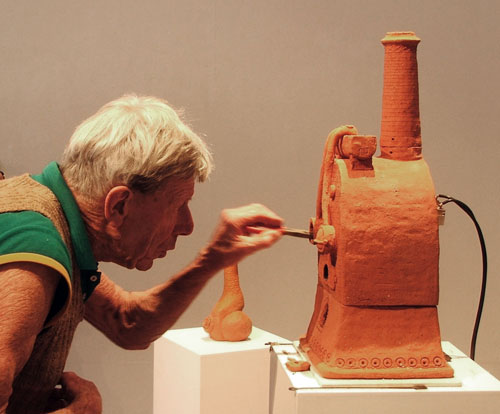


Early life and influences
Brickell was born in New Plymouth and spent his childhood in Auckland. From an early age he showed interest in materials and making, learning trades and techniques that later informed his independent studio practice. He developed a practical, experimental approach that valued doing and problem‑solving over formal academic routes.
Pottery and studio practice
As a potter Brickell produced functional wares and larger, more expressive pieces. He was known for building his own kilns and workshop equipment and for practising wood firing and other traditional firing methods that produce distinctive surface effects. His ceramics are described as earthy and tactile, reflecting close attention to materials, firing and form. Brickell’s studio was both a working space and an informal teaching place where apprentices, students and visitors observed processes from clay preparation to firing.
Driving Creek Railway and engineering
Brickell constructed the Driving Creek Railway initially to transport clay and firewood on steep terrain, and it grew into a narrow‑gauge tourist railway that winds through regenerating native forest. Built largely by hand over many years, the line incorporates tight curves, terraces, viewing platforms and stops that pass galleries and sculpture. The railway exemplifies his habit of meeting practical needs with creative solutions and has become a distinctive cultural attraction on the Coromandel.
Conservation, education and community work
Alongside making and engineering, Brickell devoted long‑term effort to reforestation and habitat restoration around his property. He established planted areas, walking tracks and an arboretum that link pottery displays with the landscape. His site functioned as a place for workshops, school visits and informal learning about craft, ecology and low‑tech engineering. His integrated approach influenced others interested in how artistic practice can contribute to environmental stewardship.
Awards, recognition and legacy
Recognised nationally for his contributions to craft and community initiatives, Brickell’s name is often given with the OBE honour. His work left a durable legacy: a working studio, an accessible railway and a restored landscape that continue to attract visitors and students. He is widely remembered for his self‑reliant ethos, inventive problem solving and the way he brought together art, industry and ecology.
Notable facts
- Official name and honour: Ian Barry Brickell OBE.
- Creator of the cultural and ecological attraction: the Driving Creek Railway.
- Key figure in pottery and craft practice within New Zealand.
- Born in New Plymouth and raised in Auckland.
Barry Brickell died on 23 January 2016 at the age of 80. His site and studio remain a testament to low‑tech ingenuity, the value of long‑term stewardship and the possibilities that arise when making and conservation are practised together.
Related articles
Author
AlegsaOnline.com Barry Brickell: New Zealand potter, railway builder and conservationist Leandro Alegsa
URL: https://en.alegsaonline.com/art/9114
Sources
- nzherald.co.nz : "Driving Creek's Barry Brickell dies"