
Seppuku: the ritual suicide of the Japanese samurai
Seppuku (often called hara-kiri) was a formal Japanese ritual of self-disembowelment performed by samurai to preserve honor, atone, protest, or avoid capture; it evolved into a regulated practice with strict procedures.
Seppuku is a historical Japanese practice in which a member of the warrior class took their own life by cutting the abdomen. The act was embedded in a broader code of honor and social expectation. In formal contexts the ceremony is called seppuku, while the popular term hara-kiri is a vernacular rendering that literally means "belly cutting." The ritualized form involved not only the primary action but also a supporting role intended to limit suffering and preserve dignity.
Image gallery
7 Images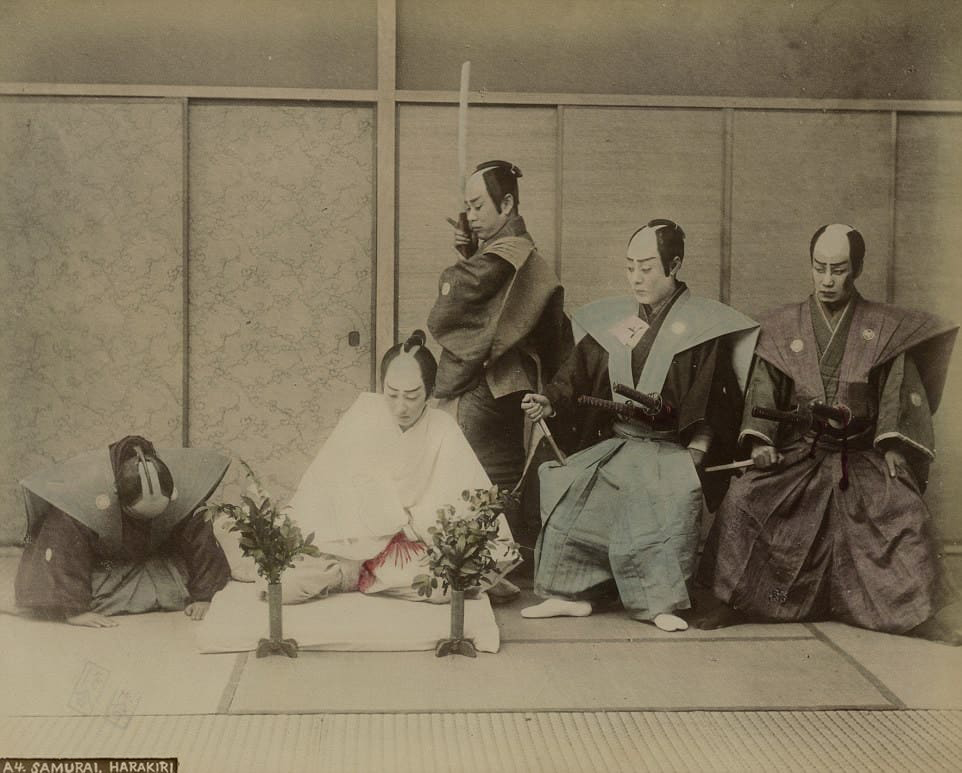


Procedure and participants
Traditional seppuku followed a prescribed series of actions. A mat, white robes, and witnesses were common; the person who performed the disembowelment faced an audience of peers or officials. A designated assistant, the kaishakunin, stood ready to perform a swift beheading after the initial cut to end the agony. The exact gestures, wording, and order could vary by era and rank, but the combination of self-inflicted abdominal wound and assisted decapitation is a widely cited characteristic. The role and presence of observers, formal statements of motive, and ritual objects underscored that seppuku was a social act, not merely a private suicide.
Reasons and occasions
Seppuku served several interrelated purposes within samurai culture and premodern Japanese society. Typical reasons included:
- atonement for failure, disgrace, or criminal behavior;
- avoiding capture on the battlefield or preventing disclosure under interrogation;
- demonstrating protest or loyalty, such as joining a deceased leader in symbolic grief;
- accepting capital punishment in a way that preserved a measure of honor.
Because it was public and ceremonial, seppuku could restore family reputation or make a moral statement: it communicated values about courage, responsibility, and the limits of shame.
Historical development
The practice emerged among warriors during the medieval period and became more codified over subsequent centuries. From the Kamakura and Muromachi periods through the Edo era, both the expectations around conduct and the legal uses of seppuku changed: what began as an impulse in warfare and ritualized mourning was later regulated as an option or sentence for samurai who had transgressed laws or broken codes of conduct. During the modernization of Japan in the nineteenth century, authorities increasingly curtailed traditional forms of punitive ritual, and the social and legal place of seppuku was transformed and reduced.
Variations, gender, and terminology
A distinct form sometimes associated with women of samurai families is often called jigai. Accounts describe different methods and settings for women, focusing on a quick end that preserved dignity; practices and historic details varied by region and rank. Linguistically, seppuku is the formal compound used in official and scholarly contexts, whereas hara-kiri is a colloquial expression. For background on the cultural framing and ritual elements, see related ritual studies and materials that examine the samurai class and behavior in historical context.
Legacy and perception
Seppuku has held a strong place in literature, theater, and later film, often serving as a symbol of uncompromising honor or tragic consequence. Modern legal and social norms make ritual suicide as a sanctioned practice obsolete; contemporary discussion tends to treat seppuku as a historical institution and a subject of cultural study rather than an acceptable action. Scholars examine it to understand how ideas of honor, obligation, and law operated in premodern Japan and to trace how those ideas were debated and transformed during periods of change.
Related articles
Author
AlegsaOnline.com Seppuku: the ritual suicide of the Japanese samurai Leandro Alegsa
URL: https://en.alegsaonline.com/art/88909