
Senate of Romania
Upper chamber of Romania's bicameral Parliament, its history, structure, functions, and role in the legislative process.
Overview
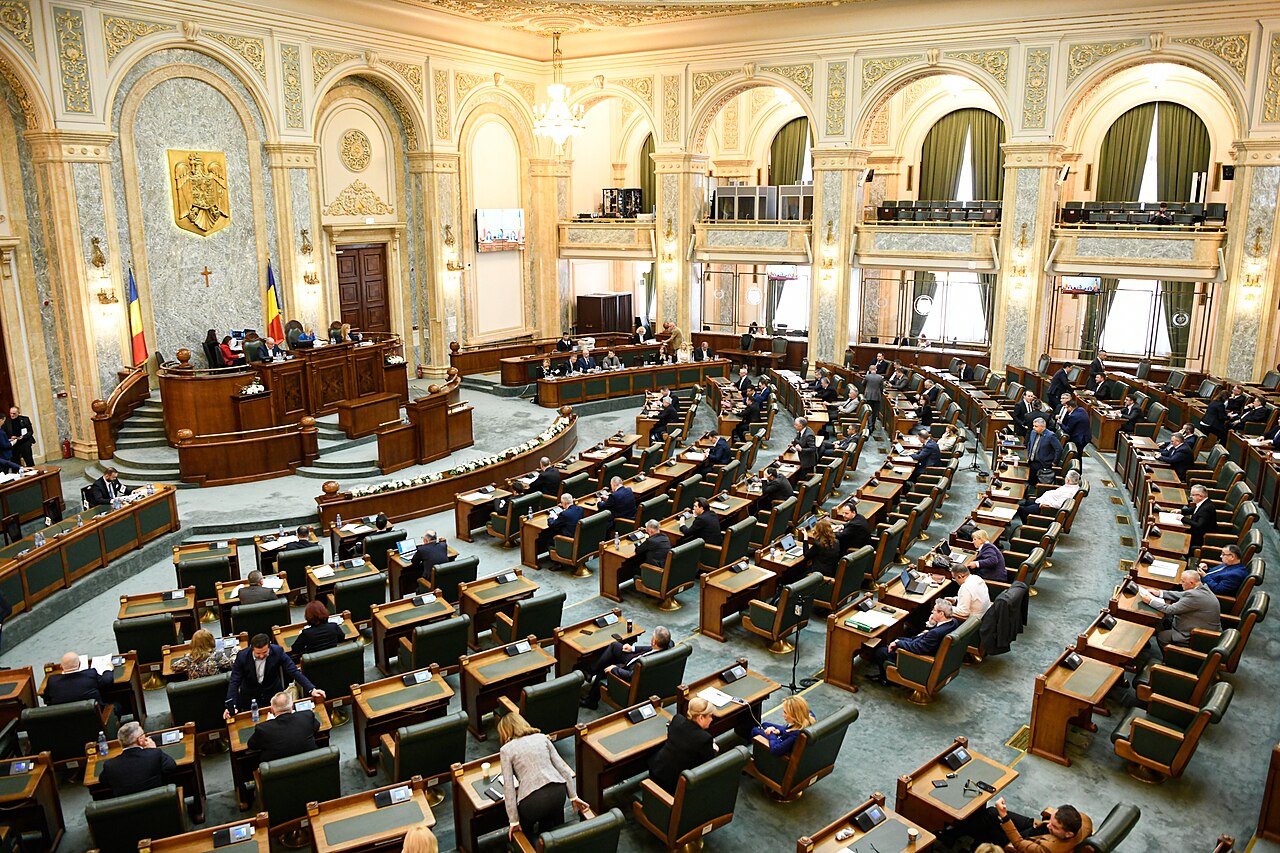
The Senate is the upper house of Romania's bicameral legislature, sitting alongside the Chamber of Deputies in the national Parliament. Its membership and internal rules have varied over time; for example, the body numbered 137 seats in 2004 according to contemporary records (2004 composition). The Senate participates in drafting, debating and adopting national laws and in exercising parliamentary oversight of the executive.
Image gallery
10 Images




Organization and functions
The Senate is led by a President (speaker) and a set of vice-presidents and committee chairs. Work is carried out through permanent committees that examine proposed legislation, budgetary matters, foreign policy and other specialized subjects. In general, the chamber:
- reviews, amends and votes on proposed laws;
- exercises oversight over government activity, including inquiries and confidence votes;
- takes part in ratifying international treaties and major state decisions;
- participates in the constitutional amendment process together with the Chamber of Deputies.
History and development
The institution has roots in Romania's pre-communist parliamentary traditions. During the communist era the legislature was restructured under single-party control and the old bicameral form was abolished. After the Romanian Revolution of 1989 the modern Senate was reconstituted and its role was formalized in the Constitution adopted in the early 1990s. Following the transition, for a time the Senate held sessions in the so-called "Palatul Senatului," a building located in Revolution Square in Bucharest.
Elections and composition
Senators are elected in national parliamentary elections for fixed terms; electoral modalities have changed at various moments, but representation is based on direct election. Party groupings and parliamentary alliances influence committee assignments and the legislative agenda. The exact number of seats and distribution among parties varies with each electoral cycle.
Role and significance
As the upper chamber, the Senate serves as a revising body that complements the work of the Chamber of Deputies. In addition to ordinary lawmaking it plays a part in shaping foreign policy decisions, supervising implementation of national policy, and confirming certain high-level appointments. Its activity is a key element of Romania's democratic system and of the checks and balances between branches of government.
Notable facts
The internal rules and relative powers of the Senate have been the subject of periodic debate and reform, reflecting broader political shifts. For current specifics on membership, leadership and committee structure consult official parliamentary sources and recent electoral reports.
Related articles
Author
AlegsaOnline.com Senate of Romania Leandro Alegsa
URL: https://en.alegsaonline.com/art/88798