
Self-similarity
Property of a shape or system that resembles a part of itself at different scales; common in fractals, natural forms, and physical phenomena with exact, statistical, and self-affine variants.
Self-similarity is the property of a shape, pattern, or system in which a part closely resembles the whole. Under magnification or scaling, similar structure recurs: small pieces look like larger ones. This idea is central to fractal geometry but also appears in natural objects and physical processes where repeating patterns persist across a range of sizes.
Image gallery
7 Images


Characteristics and types
Not all self-similarity is identical. Common types include:
- Exact self-similarity: a part is an exact scaled copy of the whole (idealized mathematical fractals).
- Statistical self-similarity: the pattern repeats in a statistical sense—details differ but overall statistics are scale-independent.
- Self-affinity: structures scale differently in different directions, so similarity requires anisotropic stretching rather than uniform scaling.
History and mathematical context
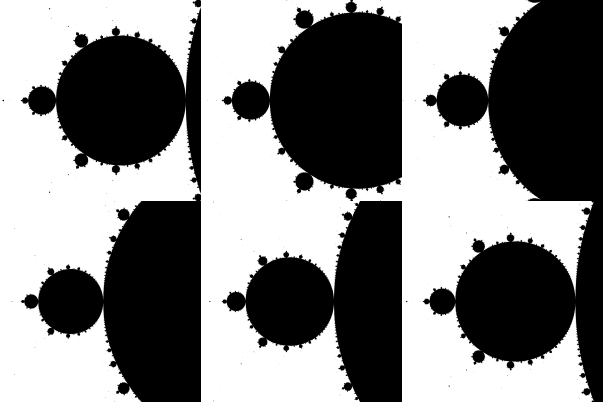
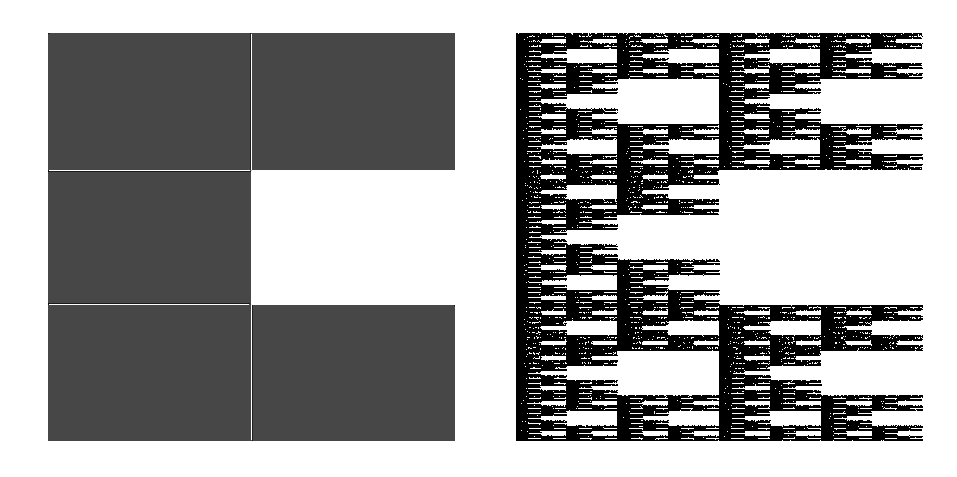
Interest in repeating patterns and scale invariance stretches back centuries in geometry and natural philosophy. In the 20th century, formal study of fractals and self-similarity advanced with iterative constructions and complex dynamics. Classic mathematical examples such as the Cantor set, the Sierpiński triangle and the Koch snowflake illustrate exact self-similarity. The complex, highly studied Mandelbrot set exhibits many miniature, near-replica structures that exemplify fractal self-similarity.
Examples and applications
Self-similarity appears in both abstract mathematics and concrete applications. Examples include:
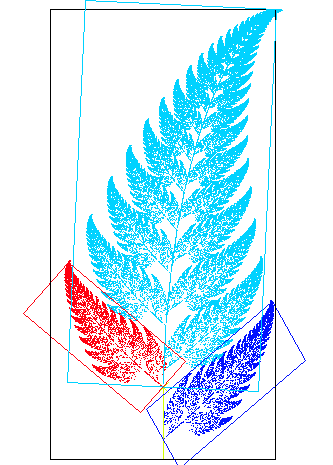
- Natural forms: branching trees, fern leaves, river networks and coastlines often show repeating motifs across scales.
- Physics: scale-free behavior near phase transitions and some turbulent flows exhibit statistical self-similarity.
- Technology: computer graphics, procedural texture generation, and data compression exploit self-similar rules to create complex visuals from simple algorithms.
Notable distinctions
Important distinctions help clarify usage. Self-similarity focuses on resemblance under scaling, whereas periodic repetition concerns translation or rotation without change of scale. Fractal dimension is a quantitative measure often associated with self-similar sets, indicating how detail increases with magnification. Finally, real-world examples are frequently only approximately self-similar across a limited range of scales, unlike ideal mathematical fractals that continue indefinitely.
Related articles
Author
AlegsaOnline.com Self-similarity Leandro Alegsa
URL: https://en.alegsaonline.com/art/88682
Sources
- mathworld.wolfram.com : "Self-Similarity - from Wolfram MathWorld"