
Seesaw (teeter-totter): playground lever, mechanics, and safety
A seesaw, or teeter-totter, is a simple lever device commonly found on playgrounds. This article explains its parts, physics, history, variations, uses, and safety considerations.
Overview
A seesaw, often called a teeter-totter in some regions, is a long, narrow board balanced on a central pivot so that when one end goes down the other goes up. It is one of the simplest and most widely recognized pieces of playground equipment. A seesaw's basic appeal is cooperative motion: two or more riders take turns pushing against the ground or shifting their position to move up and down. The device also functions as a clear, everyday example of a first‑class lever in basic mechanics.
Image gallery
8 Images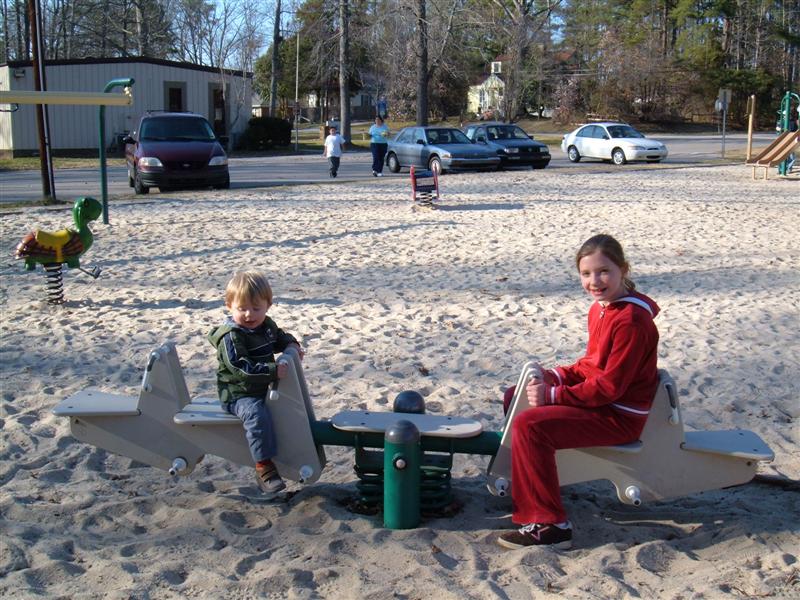


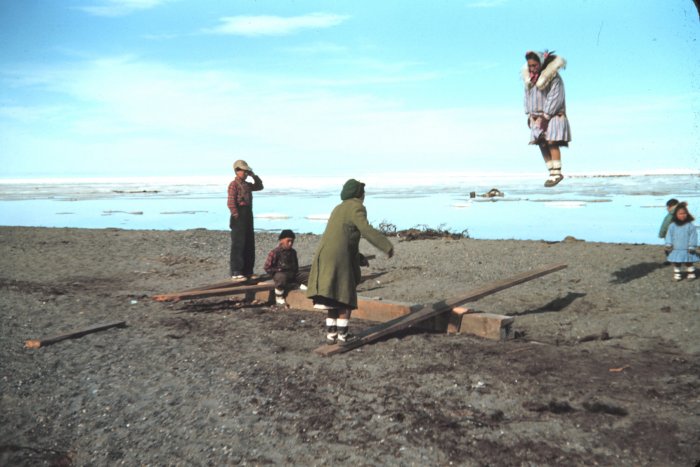
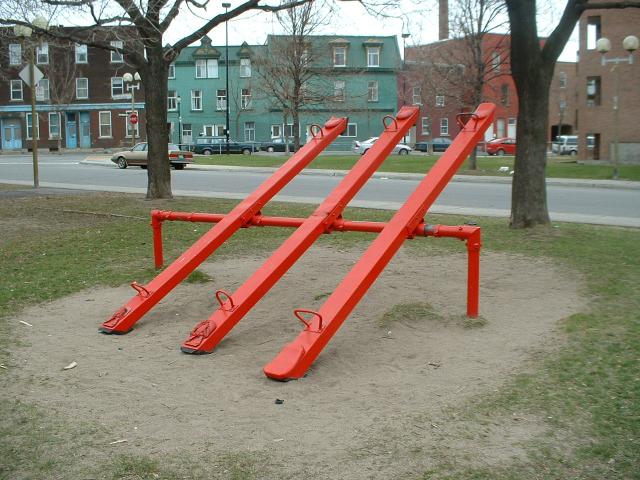

Construction and common features
Seesaws follow a straightforward design but come in several forms suited to different ages and settings. Typical components include the beam or plank that carries riders, the central support or fulcrum on which the beam pivots, seats or molded platforms at the ends, and handgrips for rider stability. Modern playground models often add spring mounts, dampers, or bump stops to control motion and reduce impact.
- Beam: usually a long, rigid plank made of wood, metal, or composite material.
- Fulcrum: the pivot point, sometimes adjustable or padded for safety.
- Seats and grips: contoured seating and handles to help riders stay secure.
- Safety features: springs, dampers, rubber bumpers, and ground clearance limits.
Basic physics and operation
A seesaw operates as a class‑1 lever: the fulcrum lies between two loads (the riders). Motion results from the imbalance of torques around the pivot. If riders differ in weight, the heavier rider's end tends to remain down; this can be countered by the lighter rider moving farther from the fulcrum or by using a seesaw with an adjustable pivot or spring assistance. The motion also demonstrates principles such as center of mass, moments (torque = force × distance from fulcrum), and rotational equilibrium when the board is level.
History, names and cultural notes
Seesaws have roots in the simple lever, a tool known since antiquity, but as a playground apparatus they emerged informally wherever children had a plank and a pivot. The terms "seesaw" and "teeter-totter" vary by region; both names are established in English and are often used interchangeably. The seesaw has become a cultural metaphor for oscillation, balance and alternating influence, appearing in literature and everyday speech to describe shifting fortunes or opinions.
Uses, benefits and modern variations
Beyond play, seesaws serve educational and therapeutic roles. They help develop balance, timing, coordination and social skills as riders learn to cooperate to achieve rhythm. Therapeutic versions can be used in physical therapy to encourage controlled weight transfer and trunk stability. Contemporary playground design has produced several variants: multi‑seat seesaws that accommodate more children, spring‑mounted rockers that limit extreme motion, and accessible seesaws designed to include riders using mobility aids.
Safety, maintenance and recommendations
Concerns about falls and impacts led to changes in seesaw design and placement. Safer equipment reduces risk with lower heights, energy‑absorbing surfaces, hand grips, and travel limits. Routine maintenance is important: inspect the fulcrum, check for rust or splits in the beam, ensure fastenings are secure, and replace worn padding. Supervision and age‑appropriate designs help prevent misuse. For younger users, bucket seats or spring models are recommended, while older children can use longer beams with proper spacing.
Playground managers and caregivers often provide supervision to encourage fair turns and to prevent one person from staying down or using excessive force. Many playgrounds combine seesaws with other devices to provide a varied environment for children to develop physical and social skills.
As a simple mechanical device and a social play tool, the seesaw remains an instructive example of balance, cooperation and design adaptation for safety and inclusion.
Questions and answers
Q: What is a seesaw?
A: A seesaw is a long, narrow board fixed in the middle, a little way above the ground, that goes up and down when one end is raised and the other end is lowered.
Q: Who usually plays on a seesaw?
A: Children usually play on a seesaw.
Q: How does a seesaw work?
A: Two children sit on opposite ends of the seesaw, and the child who is down pushes the ground with his feet so that he goes up and his friend goes down. Then the friend pushes up so the first child goes down. They continue to go back and forth until they are ready to stop playing on the seesaw.
Q: Does the weight of the children matter when playing on a seesaw?
A: Yes, it is best for two children who are about the same size to play on a seesaw, or else the heavier person will make his end stay down.
Q: Is there a limit to how many children can play on a seesaw?
A: Some seesaws have room for two or three children on each end, so there is usually a limit to how many children can play on a seesaw.
Q: Are there handles on a seesaw?
A: Yes, there is a handle for each child to hold on to so that they do not fall off.
Q: What does the term "seesaws" mean in mechanics (a kind of physics)?
A: Anything that is balanced in the middle and goes up and down like a seesaw might be described as something that "seesaws" in mechanics.
Related articles
Author
AlegsaOnline.com Seesaw (teeter-totter): playground lever, mechanics, and safety Leandro Alegsa
URL: https://en.alegsaonline.com/art/88548