
Second Rutte cabinet (Rutte II) — Dutch government, 2012–2017
Coalition government of the VVD and PvdA led by Mark Rutte from Nov 2012 to Oct 2017; carried out fiscal consolidation and social reforms, resigned as demissionary government in March 2017.
The Second Rutte cabinet, commonly called Rutte II, was the national government of the Netherlands from 5 November 2012 until 26 October 2017 (it became demissionary on 14 March 2017). Formed as a two‑party coalition, it brought together the conservative‑liberal People's Party for Freedom and Democracy (VVD) and the social‑democratic Labour Party (PvdA). The cabinet governed the Kingdom of the Netherlands under the leadership of Prime Minister Mark Rutte (VVD) with Lodewijk Asscher (PvdA) serving as Deputy Prime Minister.
Image gallery
10 Images
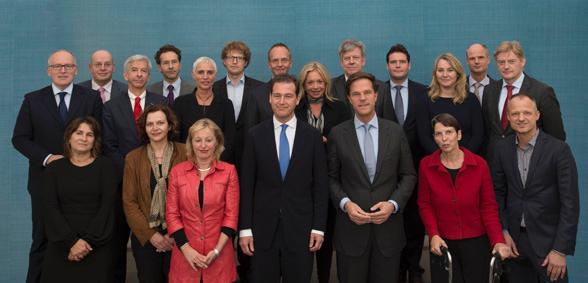


Overview and composition
Rutte II combined parties from different parts of the political spectrum and aimed to balance market‑oriented policies with social protections. Its membership included ministers and state secretaries drawn from both coalition parties. At the time of formation the cabinet had a narrow majority in the House of Representatives (Tweede Kamer) but no majority in the Senate (Eerste Kamer), which required ongoing negotiation with other parties to pass legislation.
Policy direction and priorities
The cabinet focused on reducing government deficits and restoring economic growth following the eurozone turbulence of the early 2010s. Policy directions included fiscal consolidation, labour market adjustments, and measures intended to strengthen the business climate. At the same time, the coalition pursued social policy items from the PvdA agenda, such as efforts to protect certain welfare arrangements and to address inequality through targeted programs.
Events and parliamentary context
During its term the cabinet confronted several major national and international issues, including European economic discussions, the 2015 refugee and migration pressures affecting the continent, and debates about taxation and social benefits. In November 2016 the government lost its small working majority in the House of Representatives, after which it continued to govern as a minority cabinet. On 14 March 2017 the cabinet offered its resignation and continued in a limited, caretaker (demissionary) capacity after a high‑profile controversy concerning the administration of child benefit repayments by tax authorities; it carried out only day‑to‑day and non‑controversial business until a successor was installed.
Legacy, succession and notable facts
Rutte II is often remembered for its pragmatic, consensus‑oriented style and for navigating a coalition of ideologically different partners for a full parliamentary term despite losing its majority. It was preceded by the First Rutte cabinet and succeeded by the Third Rutte cabinet. The cabinet's handling of fiscal matters, social policy trade‑offs and the child‑benefit affair remain points of study for students of contemporary Dutch politics and coalition government dynamics.
- Head of government: Mark Rutte (VVD)
- Deputy: Lodewijk Asscher (PvdA)
- Parties: VVD and PvdA
- Term: 5 November 2012 – 26 October 2017 (demissionary from 14 March 2017)
For further reading and official records consult primary sources and archives related to the cabinet's legislative program and parliamentary proceedings. Relevant summaries and timelines are available in Dutch governmental publications and contemporary news coverage of the period.
Related articles
Author
AlegsaOnline.com Second Rutte cabinet (Rutte II) — Dutch government, 2012–2017 Leandro Alegsa
URL: https://en.alegsaonline.com/art/88440