
Baltic languages
Indo-European languages of the Balto-Slavic branch spoken around the Baltic Sea, including Lithuanian, Latvian and the extinct Old Prussian; notable for conservative grammatical and phonological features.
The Baltic languages form a small but distinct group within the Indo-European family, traditionally placed in the Balto-Slavic branch. They are spoken mainly in the countries bordering the Baltic Sea and by diaspora communities. Although numerically modest compared with some European families, the Baltic languages are linguistically important because they conserve many archaic features that illuminate the history of Indo-European.
Image gallery
3 Images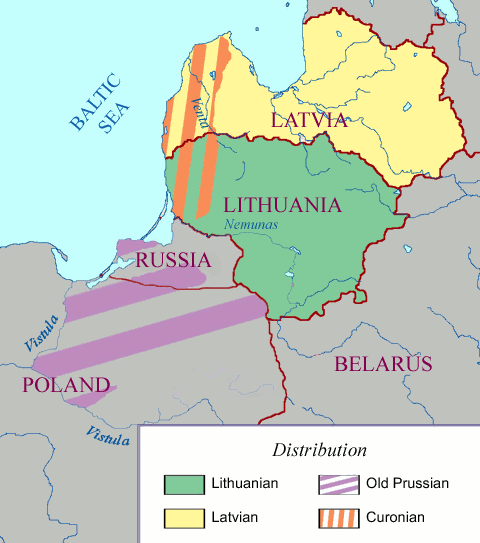


Main languages
- Lithuanian — the largest and most conservative living Baltic language; it is an official language of Lithuania and used in education, media, and literature.
- Latvian — the other extant national language, spoken in Latvia; it has several dialects and a modern standardized written form.
- Old Prussian — an East Baltic language that became extinct in the early modern period; it survives in loanwords, recorded texts and historical research.
Characteristics
- Typology: generally fusional and highly inflected, with rich noun declension and verbal morphology.
- Phonology and prosody: preserved features include conservative vowel and consonant systems and, in some varieties, remnants of pitch or stress distinctions.
- Grammar: multiple noun cases, grammatical gender, and a range of verb aspects and moods.
- Orthography: both modern languages use Latin-based alphabets with diacritics to represent specific sounds.
Historically, the Baltic languages have been classified into East Baltic (ancestral to Lithuanian and Latvian) and West Baltic (including Old Prussian). Contact with neighboring Slavic, Germanic and Finno-Ugric languages affected vocabulary and some phonetic developments. Comparative study of Baltic languages has been central to reconstructing Proto-Indo-European, because many conservative forms survived in Baltic speech longer than in other branches.
Contemporary use centers on national life, literature, education and cultural preservation. Both Lithuanian and Latvian serve as official state languages and are used in modern media, higher education, and government. Scholarly interest continues in dialectology, historical phonology and the recovery of West Baltic materials from archives and place names.
Notable distinctions include the group's small size but outsized importance to historical linguistics, the survival of archaic morphological patterns, and the pattern of long-term language contact in the Baltic region. For further context on their place within Indo-European studies, see resources on the Balto-Slavic relationship and comparative reconstructions.
Related articles
Author
AlegsaOnline.com Baltic languages Leandro Alegsa
URL: https://en.alegsaonline.com/art/8597