
Sagittarius Dwarf Elliptical Galaxy (Sag DEG)
A small, loop-shaped satellite of the Milky Way, Sag DEG is a tidally disrupted dwarf spheroidal galaxy notable for associated globular clusters and the stellar stream it supplies to our galaxy.
The Sagittarius Dwarf Elliptical Galaxy, commonly abbreviated Sag DEG and also called the Sagittarius dwarf spheroidal galaxy, is a compact satellite of the Milky Way. As a satellite galaxy, it is gravitationally bound to our galaxy but has been heavily affected by tidal forces. It was first recognized in the 1990s and has since become an important nearby example of how small galaxies are accreted and dissolved into larger systems.
Image gallery
6 Images



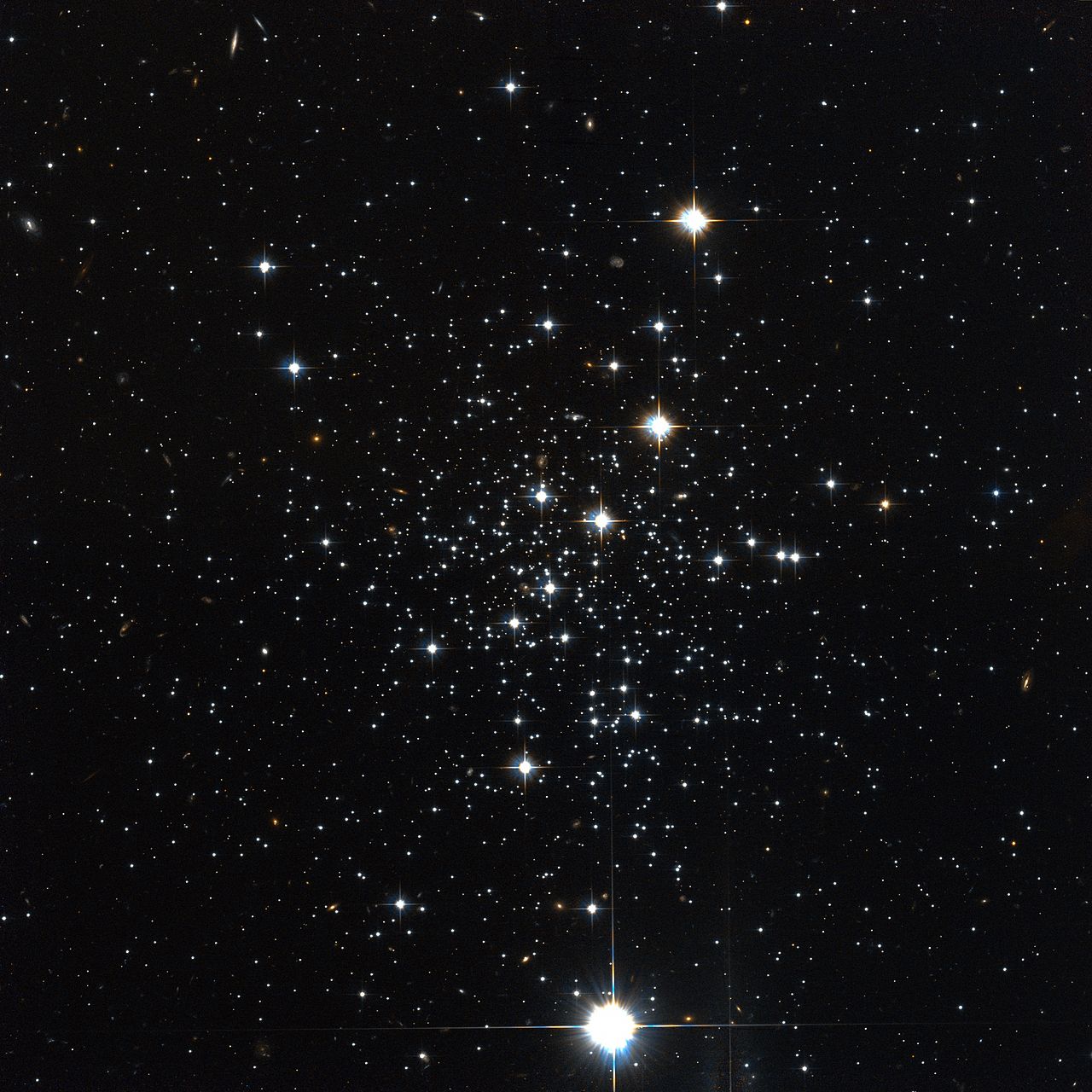

Structure and stellar content
Sag DEG is classified as a dwarf spheroidal or dwarf elliptical system: a low-luminosity galaxy dominated by old and intermediate-age stars, with little gas and no ongoing large-scale star formation. Its stellar body is elongated by tidal forces and has an estimated diameter on the order of 10,000 light-years. The system hosts several compact star clusters, including the bright globular cluster M54, which lies near its center. Astronomers associate a handful of globulars with Sag DEG; these clusters help trace its mass and history and are useful benchmarks for studying stellar populations (globular clusters).
Orbit and tidal disruption
Sag DEG orbits the Milky Way on a path that takes it through the galactic poles and across the disk. Its motion is often described as a polar, looping orbit that has carried it repeatedly through the galactic plane. Over successive passages near the Milky Way, tidal stripping has removed large numbers of stars, producing extended tidal tails and a stellar stream that wraps much of the sky. The galaxy's current center lies roughly 70,000 light-years from the Sun (distance estimate) and about 50,000 light-years from the Galactic center, though these values are approximate because the system is stretched and disrupted.
History of discovery and scientific importance
The main body of Sag DEG was identified in the mid-1990s through star-count and kinematic surveys that revealed a distinct concentration of stars moving together. Subsequent mapping of its tidal debris — the Sagittarius Stream — provided one of the clearest examples of hierarchical galaxy formation in the Local Group. Because its stars and clusters span a range of ages and chemical compositions, Sag DEG is a natural laboratory for studying how small galaxies evolve, how globular clusters form and migrate, and how the Milky Way's halo has been assembled.
- Notable associated clusters: M54, Terzan 7, Terzan 8, Arp 2 — compact groups of old stars linked to the dwarf.
- Tidal stream: long stellar streams trace the past orbit and mass loss of Sag DEG.
- Role in galactic archaeology: offers constraints on the Milky Way's gravitational potential and dark matter distribution.
It is important not to confuse Sag DEG with the similarly named Sagittarius dwarf irregular galaxy (Sag DIG), a much more distant, unrelated object. Studies of Sag DEG continue to refine its orbit, mass, and the chronology of its interactions with the Milky Way, making it a cornerstone example of galaxy merging and disruption processes in our cosmic neighborhood. For general background on related topics see satellite galaxies, the Milky Way, and resources about globular clusters and tidal streams. Additional observational data and review materials may be found via specialized catalogs and surveys referenced by astronomical databases (distance measurements, galactic structure).
Questions and answers
Q: What is Sag DEG?
A: Sag DEG is a small loop-shaped satellite galaxy of the Milky Way.
Q: What are some other names for Sag DEG?
A: Sag DEG is also known as the Sagittarius dwarf elliptical galaxy or the Sagittarius dwarf spheroidal galaxy.
Q: How many globular clusters does Sag DEG consist of?
A: Sag DEG consists of four globular clusters.
Q: When was the main cluster of Sag DEG discovered?
A: The main cluster of Sag DEG was discovered in 1994.
Q: How big is Sag DEG?
A: Sag DEG is about 10,000 light-years in diameter.
Q: How far is Sag DEG from Earth?
A: Sag DEG is about 70,000 light-years from Earth.
Q: What is the orbit of Sag DEG?
A: Sag DEG moves in a polar orbit at a distance of about 50,000 light-years from the core of the Milky Way.
Related articles
Author
AlegsaOnline.com Sagittarius Dwarf Elliptical Galaxy (Sag DEG) Leandro Alegsa
URL: https://en.alegsaonline.com/art/85231
Sources
- simbad.u-strasbg.fr : "Name SDG"
- ned.ipac.caltech.edu : "Saggitarius Dwarf Spheroidal"
- ui.adsabs.harvard.edu : 2004AJ....127.2031K
- doi.org : 10.1086/382905
- ui.adsabs.harvard.edu : 2006Ap.....49....3K
- doi.org : 10.1007/s10511-006-0002-6
- solstation.com : Sagittarius Dwarf Elliptical Galaxy / Sag DEG
- scientificamerican.com : "Star-crossed: Milky Way's spiral shape may result from a smaller galaxy's impact"