
Roustabout (1964 film)
1964 musical feature starring Elvis Presley and Barbara Stanwyck about a motorcycle-riding singer who helps revive a struggling traveling carnival.
Overview
Roustabout is a 1964 American musical drama built around a romantic and show-business premise. The film pairs rock-and-roll star Elvis Presley with veteran screen actress Barbara Stanwyck and centers on a young drifter who joins a faltering traveling carnival, becomes its attraction, and falls in love with the manager's daughter. The carnival setting supplies a backdrop for songs, romance, and backstage conflict typical of Presley’s mid-1960s movies.
Image gallery
2 Images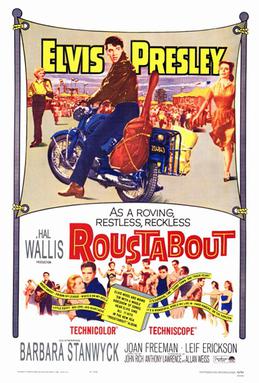

Plot and characters
The protagonist arrives as a motorcycle rider and works his way into the carnival’s ranks. He proves a charismatic performer whose singing draws audiences and rejuvenates the enterprise, while romantic tensions develop with the manager’s daughter. Along the way the story touches on loyalty, responsibility, and the conflict between showmanship and commerce. Secondary characters include the carnival manager and other troupe members who react to the newcomer's success and changing fortunes.
Cast and production notes
- Lead: Elvis Presley as the singing drifter.
- Supporting: Barbara Stanwyck, Joan Freeman, Leif Erickson, and others.
The film was produced as part of a series of studio musicals that showcased Presley’s screen presence and recording career. It uses the carnival environment both for spectacle and as a device to introduce several musical numbers and show sequences. The story and staging follow a broadly accessible, family-friendly formula intended to appeal to fans of popular music and light romance.
Music and reception
Music is central to the film’s appeal. A soundtrack with original songs and on-screen performances reinforces Elvis’s role as both actor and recording artist. Contemporary critical response tended to view the picture as entertaining but lightweight, praising Presley’s performances while noting the formulaic plot. Audiences familiar with his filmography generally regarded it as a successful example of his musical pictures.
Legacy and distinctions
Roustabout remains notable as one of Presley’s carnival-set pictures and for the contrast between his youthful star image and the presence of an established dramatic actress like Stanwyck. The carnival milieu offers a colorful setting that distinguishes the movie from other contemporaneous musicals. For readers seeking more information on the setting and historical context of traveling carnivals, see material on the genre and entertainment circuits here.
The film is often discussed within studies of 1960s popular cinema, celebrity vehicles, and the interaction between Hollywood and the recording industry. While not a breakthrough in cinematic terms, it illustrates the period’s blending of pop music and studio filmmaking and remains of interest to fans and cultural historians alike.
Related articles
Author
AlegsaOnline.com Roustabout (1964 film) Leandro Alegsa
URL: https://en.alegsaonline.com/art/84360