
Railway semaphore signal
A mechanical fixed signal used on railways that conveys movement authority by the angle of a pivoted arm; historically widespread and largely replaced by colour light signals.
Overview
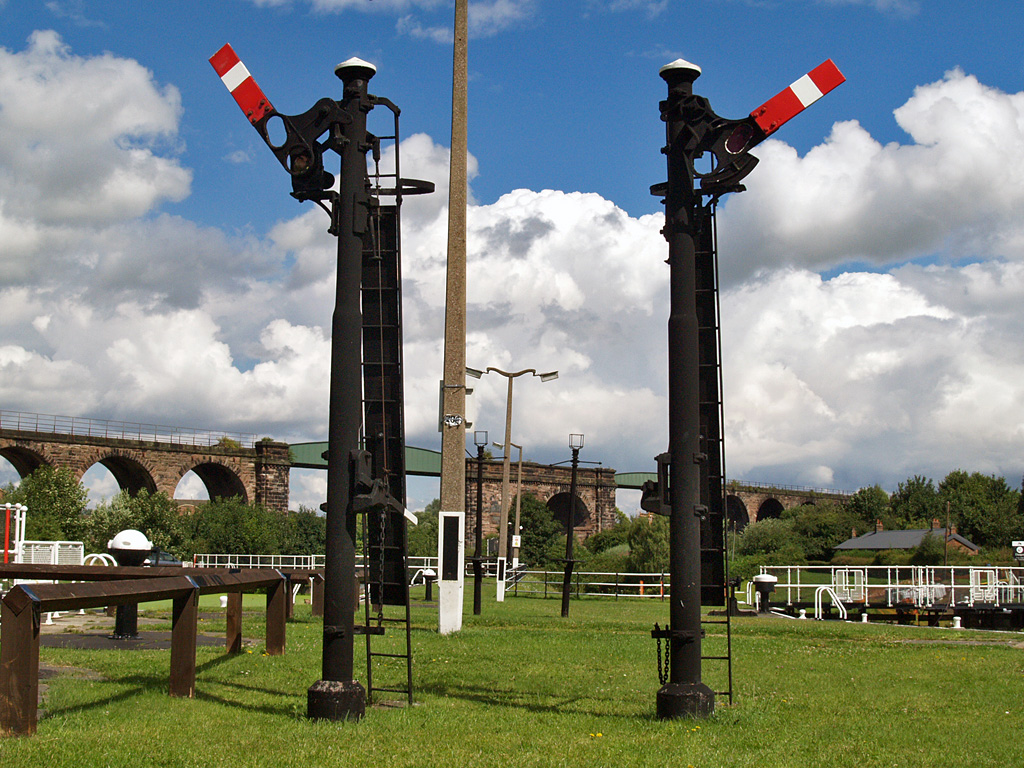
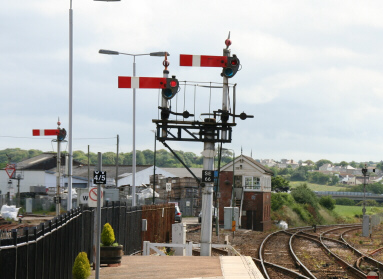
A railway semaphore signal is a fixed visual device that conveys instructions to train drivers by changing the position of a pivoted arm. The arm's inclination, and associated painted surfaces or lenses and lamps for night use, communicate whether a train must stop, proceed, or take caution. Semaphores were among the first practical fixed signals used on railways worldwide.
Image gallery
10 Images



Design and components
Typical semaphore equipment consists of a mast, one or more signal arms mounted on a spindle, counterweights, and operating linkage that connects the arm to a control point. By day the arm's shape and painted pattern are read; by night colored lenses and lamps show equivalent indications. Common elements include:
- Signal mast or post that supports the arm
- The pivoted arm (or blades) which moves between positions
- Operating rods, wires or motors that change arm position
- Illumination with coloured lenses for after-dark operation
Principles and types
Semaphores convey a small set of standard indications by distinct arm angles and aspects. For example, a horizontal arm typically means 'stop', a lowered arm indicates 'clear' and intermediate angles can mean 'caution' or 'prepare to stop'. Variants include stop signals, distant signals that warn of the next stop, and repeating or subsidiary arms used for complex junctions.
History and development
Developed in the 19th century as railways expanded, mechanical semaphores allowed distant control centres to manage train movements. Early installations were purely mechanical, using rods and wires to transmit motion. Over time some systems adopted electric motors or remote control while retaining the semaphore appearance. Their clear, intuitive operation made them a standard for many decades.
Operation, uses and importance
Signalmen or a centralized signal box set semaphore positions to protect trains, guide movements through junctions, and regulate traffic density. Their visible, analog nature provided reliable cues even where electrical infrastructure was limited. Semaphores were essential to establishing systematic block working and safer railway timetabling.
Decline and preservation
During the 20th century many railways replaced semaphores with colour light signals that require less maintenance and are easier to automate. Nevertheless, semaphores survive on some heritage lines and in preserved installations; they are also studied for their role in signalling history. For more technical detail and historical examples see further reading and related resources: signal types and operation.
Related articles
Author
AlegsaOnline.com Railway semaphore signal Leandro Alegsa
URL: https://en.alegsaonline.com/art/80884