
Princess of the Nile (1954 film)
1954 American adventure film directed by Harmon Jones, starring Debra Paget, Jeffrey Hunter and Michael Rennie; a studio-era costume adventure distributed by 20th Century Fox.
Overview
Princess of the Nile is a 1954 American adventure picture directed by Harmon Jones and released by 20th Century Fox. The film features a lead performance by Debra Paget alongside Jeffrey Hunter and Michael Rennie, with supporting appearances by Dona Drake, Michael Ansara, Edgar Barrier and Wally Cassell. Presented as a historical costume adventure, the movie draws on familiar elements of swashbuckling romance, palace intrigue and action typical of 1950s studio productions.
Image gallery
2 Images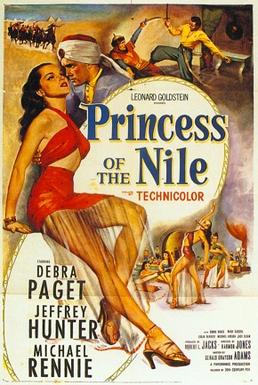

Plot and themes
Rather than focusing on strict historical accuracy, Princess of the Nile follows the conventions of mid‑century adventure films: a royal figure in danger, political rivalries, and a mixture of spectacle and personal drama. The narrative emphasizes intrigue, loyalty and romance set against an exoticized backdrop. Action sequences and dramatic confrontations drive the story, while the central character navigates shifting alliances and threats to the throne.
Cast and production
- Debra Paget – top-billed lead
- Jeffrey Hunter – principal co-star
- Michael Rennie – featured supporting role
- Dona Drake, Michael Ansara, Edgar Barrier, Wally Cassell
The film was produced within the 20th Century Fox studio system, employing the era's established craft of set design, costume work and location-like studio settings. Like many contemporaneous adventure films, it was packaged to appeal to audiences seeking escapism through exotic locales and clear-cut dramatic stakes.
Historical context
Princess of the Nile appeared during a period when Hollywood studios frequently produced historical and adventure spectacles. In the postwar 1940s and 1950s, such films offered color, large sets and romanticized visions of other times and places as competition to television increased. Stars on the rise, such as Jeffrey Hunter and Debra Paget, often appeared in these genre pieces to build broader screen profiles.
Reception and legacy
The picture is one of many mid‑century adventure films that have found modest recognition among fans of classic studio cinema. While not usually singled out as a major classic of the period, it illustrates Hollywood's formula for costume drama and the careers of its principal performers. Modern viewers and historians may approach the film as an example of studio-era production values and popular storytelling rather than as a documentary depiction of the historical setting.
Notable facts
- Directed by Harmon Jones, a filmmaker active in the studio system who worked in various genres.
- Distributed by 20th Century Fox during an era of large-scale studio output.
- The cast includes performers who continued to work in film and television, reflecting the crossover of mid‑century screen talent.
Related articles
Author
AlegsaOnline.com Princess of the Nile (1954 film) Leandro Alegsa
URL: https://en.alegsaonline.com/art/79207