
President of China
The President of the People's Republic of China is the state head whose formal duties are largely ceremonial, but who can be the country's most powerful figure when holding concurrent party and military offices.
The President of the People's Republic of China is the country's official head of state. The office represents the state in diplomatic settings, performs ceremonial duties and carries out several formal responsibilities defined by the constitution. The presidency is an institution of the state rather than a government administration post, and its practical influence depends heavily on whether the officeholder also controls the Communist Party and the armed forces. The state commonly referred to as the People's Republic of China is linked to the post by law and custom; for general context see People's Republic of China.
Image gallery
2 Images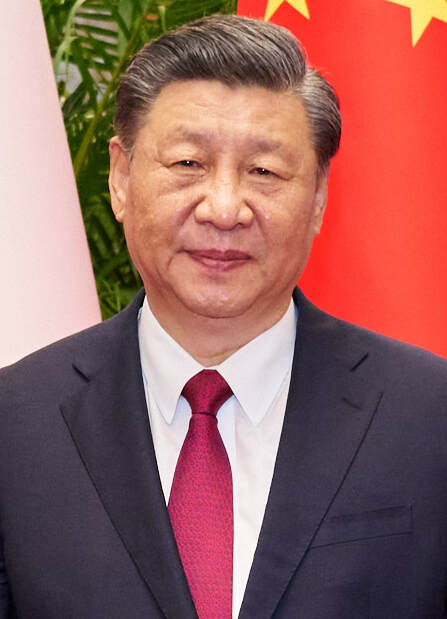

Typical functions and formal powers
Under the constitution, the president's formal tasks include promulgating laws adopted by the legislature, appointing or removing high state officials on the legislature's decision or nomination, receiving foreign envoys, and conferring state honors. The president signs treaties and important state documents and may carry out other duties as prescribed by the National People's Congress and its standing committee. Many of these actions are carried out following decisions already taken by the legislature or the Communist Party, so the role is often described as largely ceremonial on paper.
Election, terms and recent change
The president is elected by the National People's Congress (NPC), China's national legislature, which formally chooses the officeholder from nominees. After the 1982 constitution created an explicit framework for the office, the NPC set term limits of two consecutive terms to promote regular succession. In 2018 the NPC removed the two-term limit for the presidency, a modification that changed expectations about tenure and succession in China's political leadership.
Relationship with other offices
The president's real authority depends on whether the same person also serves as General Secretary of the Chinese Communist Party and as chairman of the Central Military Commission. When those three posts are held by the same individual, that person is generally recognized as the country's paramount leader and directs both party and state policy. The convergence of party, state and military roles concentrates political power and makes the presidency central to national leadership in practice; this dynamic is discussed in specialized sources about China's political system such as analyses of the paramount leader role.
History and development
The office has evolved since the first PRC constitution. It was established to provide a formal head of state, was abolished in one constitutional revision in the 1970s, and then restored with modified powers in the 1980s. Throughout its history the balance between symbolic duties and substantive authority has shifted according to institutional reforms and the distribution of power within the Communist Party.
Notable facts and current holder
In recent practice the presidency has been held concurrently with the top party and military posts, making the officeholder the leading national figure. The current president is Xi Jinping, who first assumed the presidency on 14 March 2013. Observers note that the office's influence depends less on its formal description and more on how power is distributed among China's top institutions and personalities.
- Formally a state institution with specific ceremonial and legal duties.
- Practically influential when combined with party and military leadership.
- Selected by the National People's Congress, subject to legislative procedures.
- Institutional changes—such as removal of term limits in 2018—affect expectations about tenure and succession.
Related articles
Author
AlegsaOnline.com President of China Leandro Alegsa
URL: https://en.alegsaonline.com/art/78812