
Powerbomb (professional wrestling maneuver)
A powerbomb is a wrestling slam where one combatant lifts an opponent into a seated position on the shoulders and drives them back‑first to the mat. Covers technique, variations, history and safety.
A powerbomb is a high-impact professional wrestling maneuver in which the attacking wrestler lifts an opponent so that they are seated on the attacker’s shoulders and then drives them forcefully backward onto the ring mat. It is primarily used as a dramatic finishing move or a momentum-shifting spot because of its visual force and perceived danger.
Image gallery
7 Images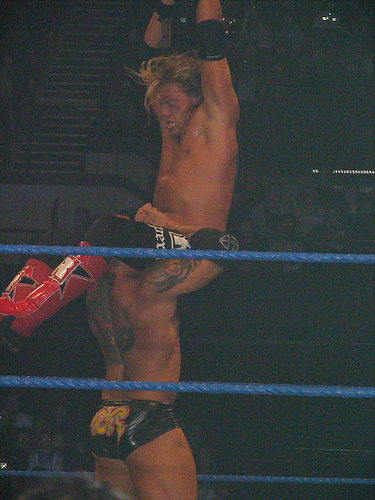

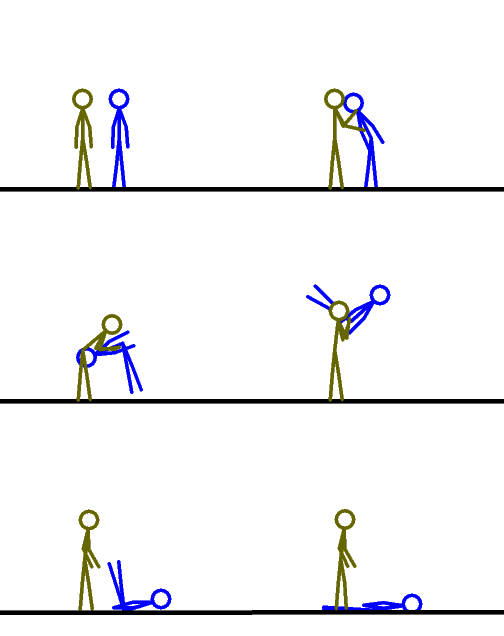


How the move is performed
Execution typically begins with the attacker positioning the opponent face-up, hooking the arms or waist to elevate them to a seated position across the attacker’s shoulders. From that position the attacker either drops to a seated or kneeling position or falls flat on their back while pushing the opponent down so that the opponent lands on their upper back and shoulders. Proper hand placement and timing between both wrestlers are essential to control the descent and reduce risk of injury.
Common variations
- Sit‑out powerbomb: the attacker sits as they complete the move so the opponent lands in a curled position.
- Jackknife powerbomb: a quick sit‑out that folds the opponent for a pinning position.
- Pop‑up powerbomb: the attacker tosses the opponent upward before catching and driving them down.
- Tornado and gutwrench variants: adding spins or different lifts to change angle and spectacle.
History and role in wrestling
The powerbomb evolved as wrestlers sought more dramatic slams suitable for televised events and pay‑per‑view finales. Over time it became a standard finisher and a staple of heavyweight and power‑style performers. Different promotions and eras emphasized different variants to suit character and safety standards.
Risks and safety
Despite choreography, the powerbomb carries real risk to the neck, spine and head if mistimed. Trainers teach body control, chin tucking, and coordinated landing to protect both participants. Because of the danger, it should only be attempted by trained professionals under supervised conditions.
For an overview of named versions and more examples, see further coverage here.
Related articles
Author
AlegsaOnline.com Powerbomb (professional wrestling maneuver) Leandro Alegsa
URL: https://en.alegsaonline.com/art/78556