
Power spectrum
How a signal's power or energy is distributed across frequency: definitions, estimation methods, examples, history, and applications in science and engineering.
Overview
The power spectrum describes how the power or energy of a time-varying signal is distributed over frequency. It answers the question: which frequencies contribute most to the signal's strength? For deterministic waveforms a power spectrum shows peaks at the harmonic frequencies; for random processes it expresses the average power per frequency and is often presented as a power spectral density (PSD). Common intuitive examples include white noise, which has roughly equal power at all frequencies (a flat spectrum), and a musical note, which concentrates power near the note's fundamental and its harmonics.
Image gallery
2 Images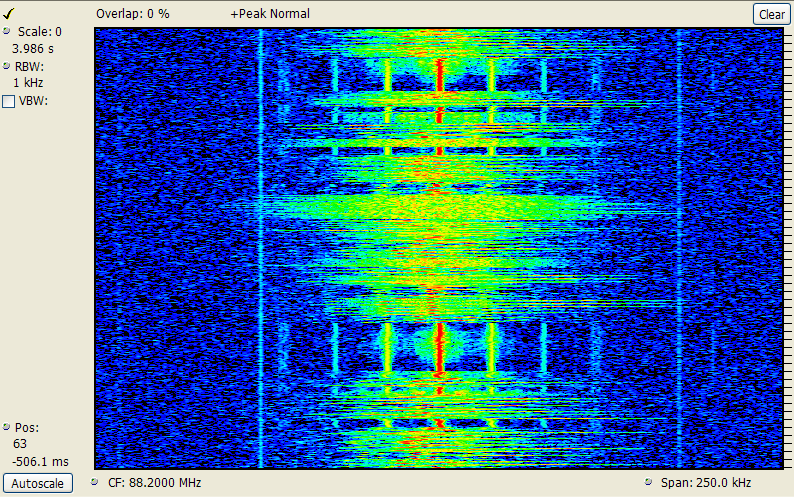

Mathematical meaning and estimation
Formally, for a stationary stochastic process the power spectrum is related to the Fourier transform of its autocorrelation function. For finite signals it is typically estimated using Fourier-based methods. The simplest estimator is the periodogram, computed from the squared magnitude of the discrete Fourier transform (DFT). Practical estimators reduce variance and leakage by averaging, windowing, or using multiple tapers: examples include Welch's method, multi-taper methods, and parametric approaches such as autoregressive (AR) spectral estimation.
Characteristics and practical considerations
Interpreting a power spectrum requires attention to resolution, variance, and bias. Frequency resolution depends on data length while spectral variance can be reduced by averaging at the cost of frequency detail. Windowing controls spectral leakage but alters peak shapes. Power spectra are often plotted on linear or logarithmic (dB) scales, and units depend on whether one reports power per bin or power per unit frequency (PSD).
History and development
The concept of decomposing signals into frequency components traces to Fourier's work on series and heat conduction. Formal statistical spectral analysis developed later as scientists and engineers applied Fourier ideas to noisy measurements. Advances in digital computation and algorithms—fast Fourier transform (FFT) and robust averaging techniques—made practical spectral estimation routine in the twentieth century.
Applications and examples
- Audio and acoustics: identifying tones, timbre, and noise characteristics.
- Communications: channel analysis, modulation and interference detection.
- Geophysics and seismology: characterizing seismic waves and Earth noise spectra.
- Biomedical signals: EEG and heart rate variability analysis use spectral bands linked to physiological states.
- Astronomy and engineering diagnostics: finding periodicities or resonances in data.
Distinctions and notable facts
"Power spectrum" and "power spectral density" are related but not identical: PSD conveys power per unit frequency and is suitable for continuous spectra, while a discrete spectrum lists power at separate frequency lines. The amplitude spectrum (square root of power) and phase spectrum give complementary information. Because real measurements are finite and noisy, spectral estimates are approximations that must be interpreted with knowledge of the chosen estimator and its limitations.
Related articles
Author
AlegsaOnline.com Power spectrum Leandro Alegsa
URL: https://en.alegsaonline.com/art/78548