
Potassium sulfate (K2SO4): properties, uses, and history
Potassium sulfate (K2SO4) is a white crystalline salt supplying potassium and sulfur. Widely used as a chloride-free fertilizer, it also has roles in industry and chemistry and occurs naturally as arcanite.
Potassium sulfate, chemical formula K2SO4, is an ionic salt composed of potassium cations and sulfate anions. Often encountered as a white, odorless crystalline solid, it dissolves in water to yield K+ and SO4^2- ions and is chemically neutral in solution. It is known in mineral form as arcanite and appears in nature in evaporite deposits and as a minor component of some volcanic fumaroles.
Image gallery
6 Images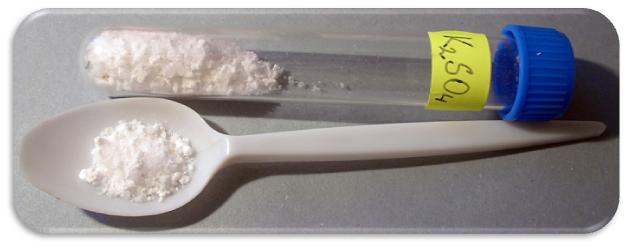


Characteristics and chemistry
As a source of two essential nutrients—potassium and sulfur—potassium sulfate behaves as a typical sulfate salt. It is less soluble in water than many simple chlorides and is not a strong oxidizer. Its ionic composition can be described in simple terms: the potassium portion supplies plant-available K+, while the sulfate supplies SO4^2- which can be assimilated as sulfur. Chemically stable under normal storage conditions, it does not readily hydrolyze or decompose at ambient temperatures.
Production and history
Historically the mineral arcanite was the earliest known form, but most potassium sulfate used today is produced industrially. Manufacturing routes include recovery from natural salts, conversion of potassium-containing feedstocks, and purification steps during potash refining. Industrial production developed alongside the fertilizer industry as agronomists recognized the separate roles of potassium and sulfur in crop nutrition.
Uses and applications
The primary application of K2SO4 is agricultural: it is a valued fertilizer for supplying potassium without adding chloride, which can be harmful to chloride-sensitive crops such as tobacco, certain fruits, and some vegetables. Beyond agriculture, potassium sulfate finds occasional use in glass and ceramic formulations, certain laboratory reagents, and specialized industrial processes that require a neutral potassium salt. It also appears in formulations where chloride ions must be avoided.
Practical considerations and safety
- Advantages: supplies two essential nutrients, chloride-free, relatively stable.
- Handling: generally low in acute toxicity, but dust can irritate eyes and respiratory tract; standard industrial hygiene practices apply.
- Environmental: beneficial as a nutrient source but, like all soluble salts, can contribute to salinity if overapplied.
Further reading
For concise chemical and industrial summaries see general references on chemical compounds and entries specifically addressing potassium as an element (potassium) and the sulfate anion (sulfate). These sources provide broader context on how K2SO4 relates to other common salts and its role in plant nutrition and manufacturing.
Related articles
Author
AlegsaOnline.com Potassium sulfate (K2SO4): properties, uses, and history Leandro Alegsa
URL: https://en.alegsaonline.com/art/78426