
Avon (county) — former English county, 1974–1996
Former non-metropolitan county in South West England created in 1974 and abolished in 1996; it covered Bristol, Bath and neighbouring areas before being divided into unitary authorities.
Overview
Avon was an administrative county in England that existed from 1 April 1974 until 31 March 1996. It was created as part of a nationwide reorganisation of local government and brought together the city of Bristol, the city of Bath and surrounding towns and suburbs into a single county authority. The name came from the River Avon which crosses the area. Avon lay within South West England and was intended to provide coordinated services across an urban and suburban corridor that straddled historic county boundaries.
Image gallery
1 Image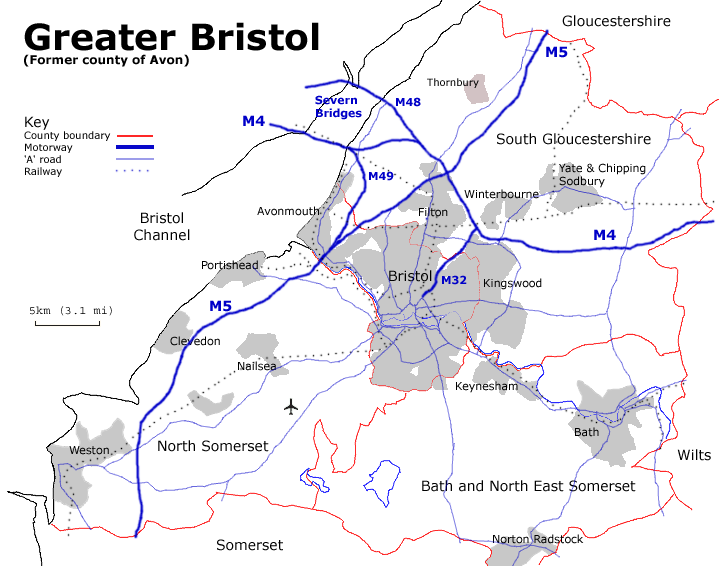
Geography and components
The county included the two main urban centres, Bath and Bristol, plus outlying districts drawn from parts of historic Somerset and Gloucestershire. Its boundaries were designed around transport links and the river valleys rather than older county lines. Administratively it combined responsibilities such as education, transport planning and strategic services for the whole area while local district councils handled more local functions.
History and administration
Avon was established under the Local Government Act 1972 and governed by Avon County Council together with district councils beneath it. The arrangement was controversial from the start: many residents and local organisations continued to identify with Somerset, Gloucestershire or the cities of Bristol and Bath rather than with the new administrative name. After a period of review of local government in the 1990s, Avon was abolished in 1996 and its functions were devolved to new unitary authorities.
Successors and legacy
When Avon was dissolved its area was divided into separate unitary councils. The principal successor authorities were:
- City of Bristol (unitary authority) — the metropolitan core centred on Bristol (Bristol).
- Bath and North East Somerset — covering Bath and nearby rural and suburban areas, largely from historic Somerset.
- North Somerset — the coastal and rural parts to the west of Bristol, formed from former Avon districts.
- South Gloucestershire — areas to the north and east of Bristol, drawing on parts formerly in Gloucestershire.
Although short-lived, Avon's creation and abolition are commonly cited in discussions about local identity, the balance between regional planning and historic counties, and the challenge of designing administrative boundaries that reflect both practical needs and people’s sense of place. Maps, records and administrative histories from the period continue to use the name Avon for the 1974–1996 era.
Tags
Related articles
Author
AlegsaOnline.com Avon (county) — former English county, 1974–1996 Leandro Alegsa
URL: https://en.alegsaonline.com/art/7771