
Polans (Polanie): West Slavic tribe of Greater Poland
Polans (Polanie) were a West Slavic tribe in the Greater Poland region whose consolidation under the Piast rulers led to the early Polish state; they are distinct from the East Slavic Polans.
Overview
The Polans (Polanie) were a West Slavic people settled in the area known today as Greater Poland (Wielkopolska). They are best known for creating the core of the early Polish polity by bringing neighboring Slavic groups under a single rule. In historical and archaeological literature the Polans appear as a formative force in Central Europe during the early medieval period.
Image gallery
4 Images


Location, name and identity
The name Polans is commonly derived from the Slavic root "pole" meaning "field" or "open area," suggesting an agricultural, lowland community. Their territory was centered on river basins in what is now west-central Poland, with important early centers around the modern cities of Poznań and Gniezno. Contemporary chroniclers and later historians classify them among the West Slavic peoples and refer to them as a tribe rather than a united nation until consolidation under local rulers.
Political development and the rise of the Piasts
From a network of fortified settlements and local chieftains the Polans developed more centralized rule under the dynasty later called the Piasts. Through alliances, conquest and dynastic expansion they absorbed or subordinated neighboring Slavic groups and created a territorial basis for the medieval state commonly called Poland. The conversion of the ruling prince, often identified as Mieszko I, to Christianity was a pivotal moment: it tied the emerging polity into wider European religious and diplomatic systems and strengthened internal cohesion.
Society, economy and material culture
Polanic society was largely agrarian, organized around villages and manorial areas with seasonal farming, animal husbandry and woodland exploitation. Key features of their material culture include fortified settlements (gords), which served as political, economic and defensive centers; craft production such as metalwork and pottery; and riverine trade routes that linked inland communities to Baltic and continental markets. Burial practices, settlement patterns and artifacts recovered by archaeologists provide the primary non-literary evidence used to reconstruct their way of life.
Sources, scholarship and historical accounts
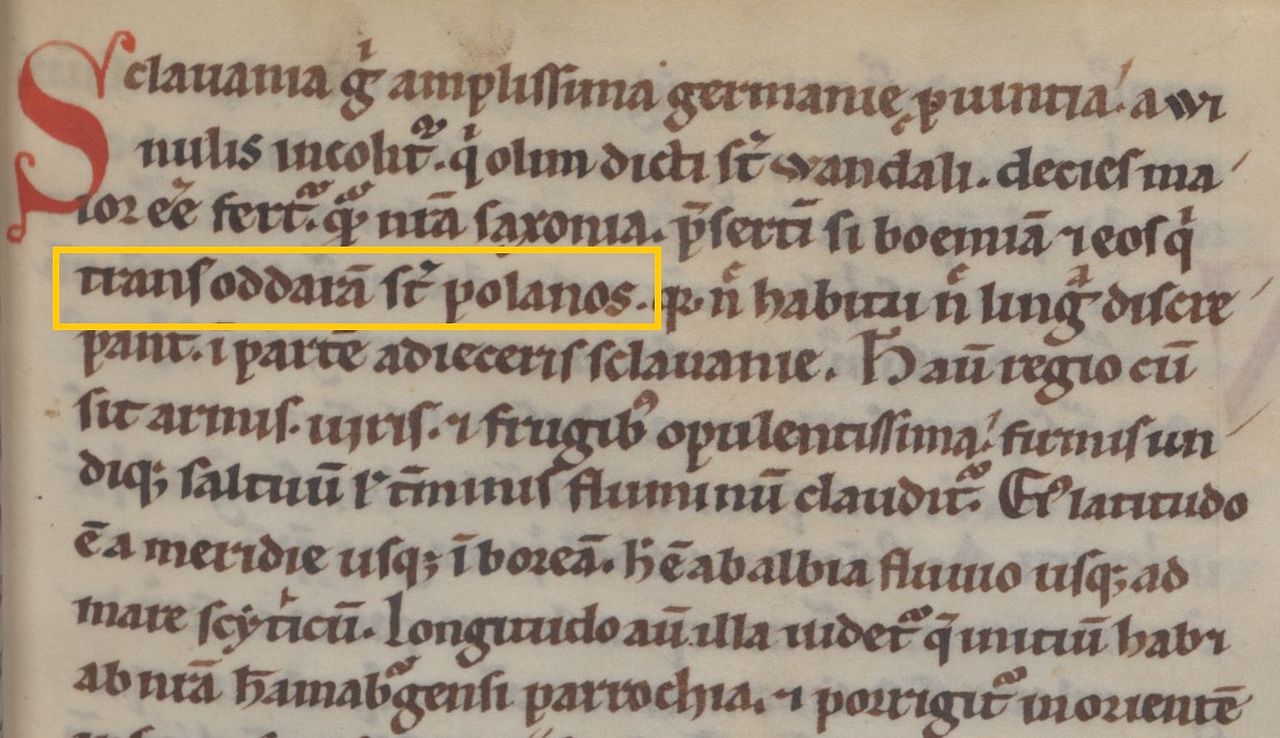
Written references to the Polans are limited and often come from external chroniclers who described the peoples of the Baltic and Central European littoral. One medieval source that mentions Slavic peoples in this region is Helmold's Chronica Slavorum, which situates various tribes along the southern Baltic coast and remarks on neighbors and bordering peoples. Such accounts must be read critically and compared with archaeological results because medieval authors sometimes used broad or imprecise ethnographic categories.
Distinctions and legacy
It is important to distinguish the Polans of Greater Poland from a different group sometimes called the Polans in East Slavic contexts (the Dnieper Polans). The West Slavic Polans are central to Polish national history because their political consolidation under the Piasts provided the institutional foundation for the medieval Kingdom of Poland. Their legacy survives in regional identity, place names and archaeological sites that are studied to illuminate early medieval state formation in Central Europe.
- Key terms: Polanie (native name), gord (fortified settlement)
- Major figures: local Piast rulers and the Christianizing prince Mieszko I
- Further reading: primary chronicles and archaeological syntheses (ethnographic context, tribal classification, state formation)
Related articles
Author
AlegsaOnline.com Polans (Polanie): West Slavic tribe of Greater Poland Leandro Alegsa
URL: https://en.alegsaonline.com/art/77693