
Peter Henlein — early Nuremberg locksmith and pioneer of portable timepieces
Peter Henlein (c.1479–1542) was a Nuremberg locksmith known for producing small spring-driven portable clocks. He is often credited with early watches, an attribution that is historically debated.
Peter Henlein (born c.1479–1480; died August 1542) was a locksmith and clockmaker active in the German city of Nuremberg. He is widely remembered as one of the first craftsmen to produce very small, portable spring-driven timepieces around the beginning of the 16th century, and popular accounts sometimes call him the inventor of the watch. Modern scholarship treats that claim cautiously: while Henlein was a leading maker of compact clocks, the technical foundations for spring-driven timepieces predated him.
Image gallery
8 Images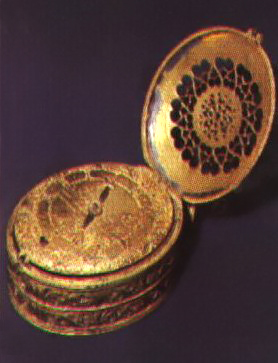


Characteristics and construction
The small timepieces associated with Henlein were typically drum- or egg-shaped cases, often richly ornamented and sized to be worn on a chain, carried in a pouch, or kept in a pocket. Internally they depended on a coiled mainspring to store energy and an escapement to regulate motion. Early examples from this period usually employed a verge escapement and a foliot or simple balance wheel, and they commonly indicated only the hour. Running durations between windings varied; contemporary descriptions suggest runs on the order of a day or two.
- Mainspring-powered — allowed miniaturization compared with weight-driven clocks.
- Verge escapement and simple balance systems — limited accuracy by later standards.
- Single hand — hour indication was the norm for early portable pieces.
- Decorative cases — made them luxury objects and status symbols.
Historical context and development
Spring-driven mechanisms and small portable clocks began to appear in Europe in the 15th century; surviving descriptions and a few artifacts show that clockmakers were experimenting with springs before Henlein's active years. What Henlein appears to have done was refine and popularize very small, wearable clocks in Nuremberg during the early 1500s. Dated references and attributions place some of his work roughly between 1504 and 1510, a period when Nuremberg was a thriving center of metalwork, engraving and mechanical craft.
Uses, social importance and legacy
Early portable watches were prized more for their novelty and ornament than for precision. They served as personal status objects, portable alarms and curiosities for wealthy owners. Over the course of the 16th and 17th centuries, improvements in escapements and the later invention of the balance spring (hairspring) improved accuracy dramatically; the refinement of portable timekeeping influenced daily life, commerce and, eventually, navigation. Henlein's work is often cited as an important step toward the widespread use of personal timepieces.
Notable facts and scholarly view
Attributions linking particular surviving objects directly to Henlein are tentative: few pieces can be securely documented to an individual maker from this era, and period records are limited. Historians therefore emphasize Henlein's role as an influential early maker and popularizer of small portable clocks rather than the sole inventor of the watch. For broader discussion of the origins of portable clocks and watchmaking, see general surveys of horological history and studies of early German workshops, or consult resources on the history of the watch.
Although later developments — notably the balance spring in the 17th century — brought the accuracy expected of modern watches, the early 16th-century portable clocks associated with craftsmen like Henlein mark a clear shift from stationary public timekeeping toward personal, wearable timepieces and the social changes that accompanied that shift.
Related articles
Author
AlegsaOnline.com Peter Henlein — early Nuremberg locksmith and pioneer of portable timepieces Leandro Alegsa
URL: https://en.alegsaonline.com/art/76097
Sources
- books.google.com : "Clock"
- books.google.com : A History of Mechanical Inventions
- books.google.com : History of the Hour: Clocks and Modern Temporal Orders
- german.about.com : "It's About (German) Time"