
Peripheral vision: function, anatomy, and everyday importance
Peripheral vision is the ability to detect objects, motion and light outside the direct line of sight. This article explains its anatomy, characteristics, clinical testing, everyday roles and notable facts.
Overview — Peripheral vision refers to what the eyes can perceive outside the small central region used for detailed sight. It provides awareness of the broader visual scene: movement, changes in light, and the presence of nearby objects that fall outside the direct line of gaze.
Image gallery
4 Images
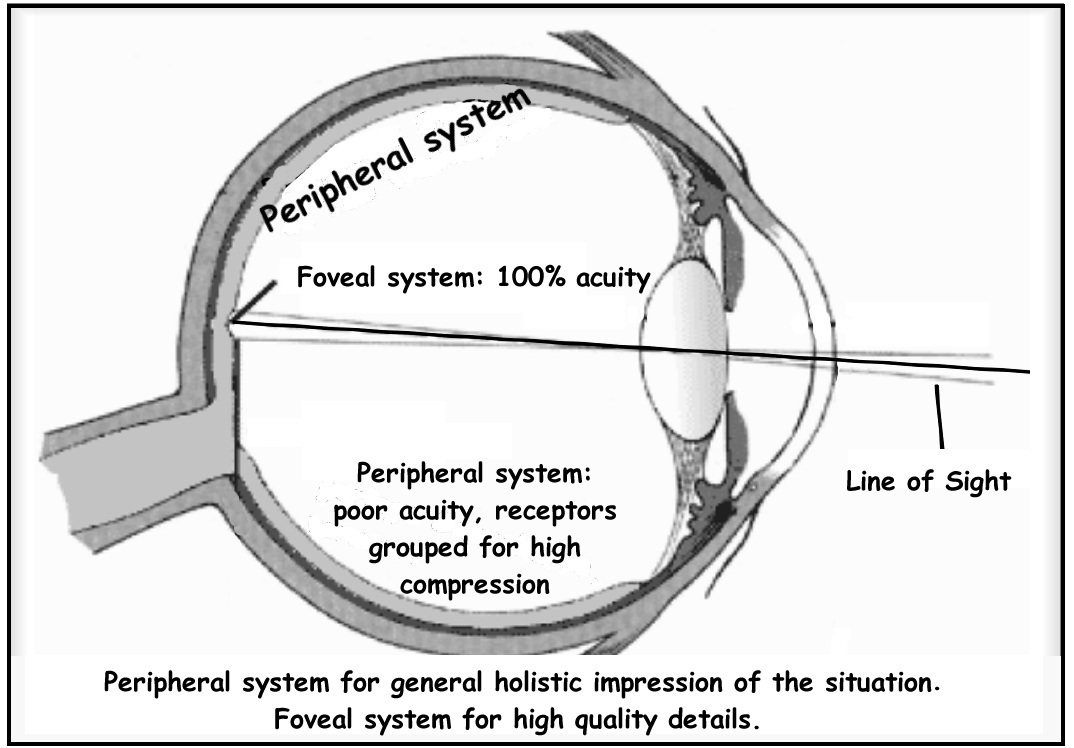


Anatomy and how it works
The retina is not uniform: the fovea in the center concentrates cones for high-resolution, color vision, while the peripheral retina contains more rods that are sensitive to dim light and motion. Signals from peripheral photoreceptors travel through the optic nerve and visual pathways to brain regions that integrate spatial and motion information.
Characteristics
Peripheral vision has lower spatial acuity and weaker color discrimination than central vision, but it is better at detecting motion and working in low light. The brain combines central and peripheral inputs, switching attention and using eye movements (saccades) to bring important details into central view when needed.
Testing and clinical significance
Clinicians assess peripheral fields with confrontation testing and automated perimetry to find defects. Loss of peripheral vision can arise from glaucoma, retinal diseases (such as retinitis pigmentosa), optic nerve damage, or brain injuries and strokes. Symptoms include "tunnel vision" or blind spots that affect safety and mobility.
Everyday importance and training
Peripheral vision supports balance, navigation, driving, and sports by signaling hazards and opponents in the environment. Athletes and drivers practice expanding their awareness and scanning strategies; however, anatomical limits mean training improves attention and scanning more than raw peripheral acuity.
Notable facts and distinctions
- Crowding: objects in the periphery are harder to identify when flanked by other items.
- Night adaptation: peripheral rods are crucial for seeing in low light but convey less detail.
- Blindsight and unconscious perception: rare brain conditions can leave conscious central vision intact while subconscious peripheral responses remain or vice versa.
Related articles
Author
AlegsaOnline.com Peripheral vision: function, anatomy, and everyday importance Leandro Alegsa
URL: https://en.alegsaonline.com/art/75839