
Palmyra Atoll: Remote Pacific Atoll and National Wildlife Refuge
Uninhabited coral atoll in the North Pacific, managed as a U.S. National Wildlife Refuge and used seasonally by researchers for ecological, marine and climate studies.
Overview
Palmyra Atoll is a remote, low-lying coral atoll located in the North Pacific Ocean. It has no permanent population; instead small groups of scientists, conservation staff and occasional visitors (typically between four and twenty people at a time) live on the islands for short periods. The atoll is best known for its relatively intact reef and island ecosystems, which make it valuable for long-term ecological research.
Image gallery
10 Images
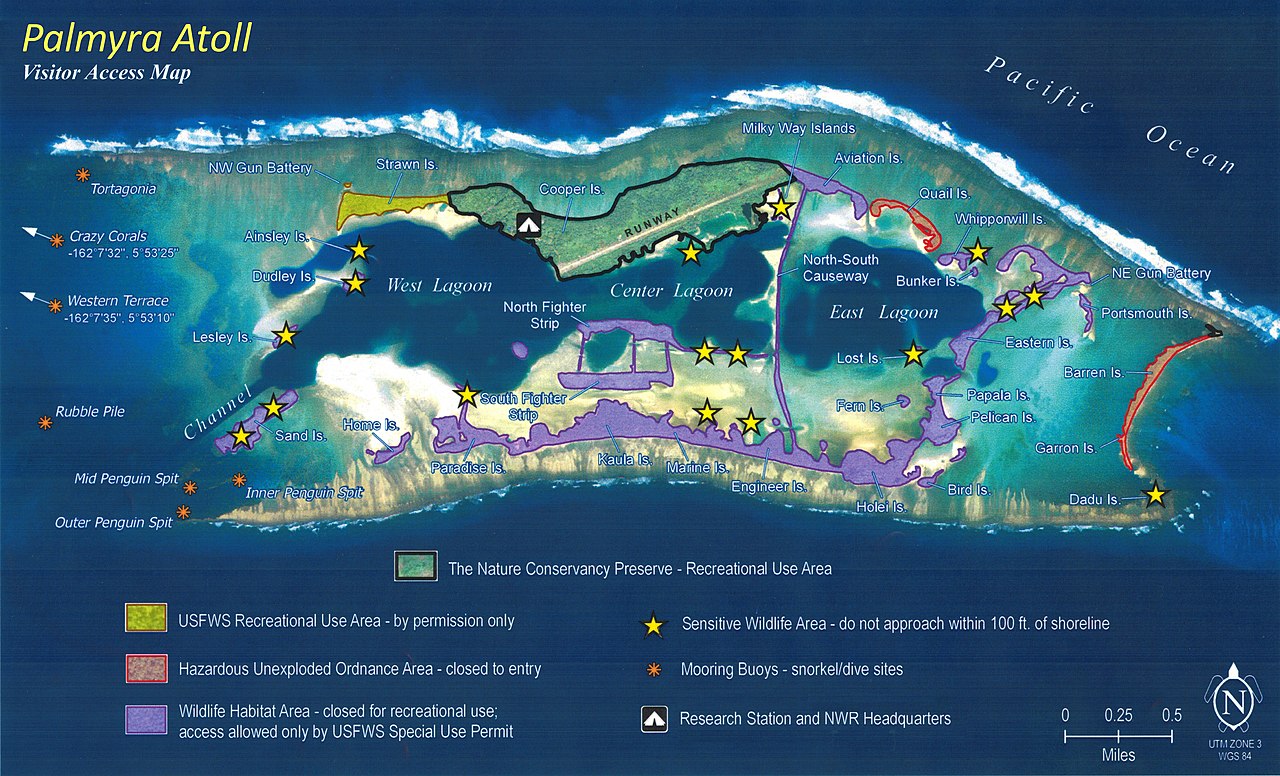


Geography and ecology
As a classic atoll, Palmyra consists of a ring of small islets surrounding a shallow central lagoon. Vegetation includes coastal forest and strand plants, and the islands support large colonies of seabirds and nesting sea turtles. The surrounding coral reef hosts diverse marine life, making the atoll an important site for studies of coral health, reef fish communities and oceanic processes.
History and human presence
Palmyra has a history of intermittent human use rather than continuous habitation. It was visited by seafarers and later saw brief military activity during the 20th century. In recent decades the atoll has been maintained primarily for conservation and science, with a modest research station established to support systematic studies and monitoring.
Research, conservation and management
The atoll is managed as a nature reserve under U.S. authority and is commonly referred to as the Palmyra Atoll National Wildlife Refuge; conservation organizations also work there in partnership with the United States to protect habitats. Research teams study topics such as coral reef ecology, seabird populations, invasive species control, and the ecological effects of climate change and sea-level rise. In 2005 and subsequent years, scientists expanded facilities to support multi-year research projects and monitoring programs.
Importance and notable features
- Remoteness: the atoll’s isolation helps preserve species assemblages rarely seen on more impacted islands.
- Baseline science: it provides a reference for understanding undisturbed tropical island and reef ecosystems.
- Conservation testing ground: managers use Palmyra to develop and demonstrate restoration techniques, such as invasive species eradication and coral resilience studies.
Access is restricted and generally requires permission for research or conservation purposes. Because of its ecological value, Palmyra continues to attract international scientific interest as a living laboratory for studying natural processes and human impacts on island and marine environments.
Related articles
Author
AlegsaOnline.com Palmyra Atoll: Remote Pacific Atoll and National Wildlife Refuge Leandro Alegsa
URL: https://en.alegsaonline.com/art/74247
Sources
- cia.gov : "Palmyra Atoll" at CIA World Factbook