
Northern City Line — Moorgate to Finsbury Park commuter railway
A short National Rail route linking Moorgate and Finsbury Park in north‑east London. Originally the Great Northern & City Railway, now a suburban commuter corridor into the City of London.
Overview
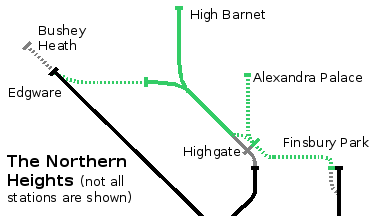
The Northern City Line is a short but historically distinct suburban railway running between Moorgate in the City of London and Finsbury Park in north‑east London. It provides a direct rail approach into the City for commuter services and forms a link between central London and longer suburban routes to the north.
Image gallery
7 Images


Origins and development
The line began life in the early 20th century as the Great Northern & City Railway, built with unusually large tunnels intended to accept mainline rolling stock. Its original purpose was to carry suburban and mainline trains closer to the finance district, but for many years it operated in isolation from the surface rail network. Over the 20th century the line changed hands and operational arrangements, and was eventually incorporated into the National Rail suburban network, allowing through running of commuter services.
Route and operation
The route runs beneath densely built inner‑city streets between its termini, serving inner‑London neighbourhoods and providing interchange at both ends with other rail and Underground lines. Trains on the line are part of the suburban commuter timetable and terminate at Moorgate in the City during peak and off‑peak hours. At the northern end passengers can connect at Finsbury Park to longer distance and Underground services.
Characteristics and uses
- Built to a larger tunnel size than many deep‑level tube lines so it could, in principle, take mainline stock.
- Important for commuter access into the City of London, particularly during weekday peaks.
- Operated as part of the National Rail network rather than as an Underground route, unlike the nearby City branch of the Northern line.
Distinctions and notable facts
The Northern City Line is often confused with other north London routes. It is distinct from the orbital North London line, and from the Northern line's City branch, both of which serve different corridors and operate under different systems. Its unique history—originally envisaged as a mainline connection into the City but later functioning as a suburban commuter artery—gives it a special place in London's rail network.
Related articles
Author
AlegsaOnline.com Northern City Line — Moorgate to Finsbury Park commuter railway Leandro Alegsa
URL: https://en.alegsaonline.com/art/71013