
Northern line (London Underground)
Deep-level London Underground line, coloured black on the Tube map. Notable for two central routes, multiple northern branches and a long southern extension to Morden and Battersea.
The Northern line is one of the principal deep-level routes on the London Underground, shown in black on the official Tube map. It has a complex route structure with two separate central tunnels and multiple northern branches that together serve a wide swathe of north and south London. The line is notable both for its Victorian origins — part of it dates to the first deep-level tube in the 1890s — and for its status as one of the busiest routes on the Underground network.
Image gallery
6 Images


Overview and route
The Northern line runs from a single southern terminus at Morden through central London and splits to serve more than one destination in the north. Historically it incorporates several distinct railway companies and was gradually linked into a through route. For most of its length the line runs in deep tunnels, with many platforms well below street level; overall the route serves around fifty stations, several of which are deep-level tube platforms rather than sub-surface or surface platforms.
Its central section is unusual among London lines because there are two alternative alignments through central London — commonly called the Bank branch and the Charing Cross branch — that provide different interchanges and reach different central points. To the north the line divides into branches, while to the south it runs to Morden and, since recent works, to the Battersea area, creating additional operational flexibility.
Characteristics and notable features
- Deep-level construction: much of the route is bored tube tunnel, including the oldest deep-level section between Stockwell and Borough, opened in the late 19th century.
- Two central tunnels: the Bank and Charing Cross central routings give passengers alternative ways to cross the centre, but they also make the line’s scheduling and service patterns more complicated than on a single-track route.
- Map identity: the line is represented in black on the Tube map and is often referred to simply as "the Northern" in passenger information and operations.
- Geographical oddities: despite its name, the Northern line does not include the absolute northernmost stations on the London network, yet it reaches well into south London and includes the southernmost terminus at Morden; many stations south of the River are served.
History and development
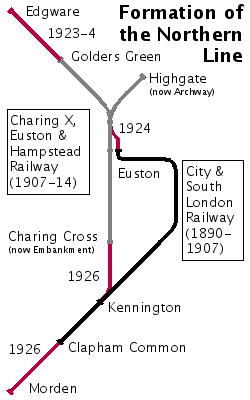
The present-day Northern line emerged from the amalgamation of several independent tube railways built in the late 19th and early 20th centuries. The City & South London Railway — one of the world’s earliest deep-level electric railways — opened the first section that later became part of the Northern line. Over subsequent decades other companies built nearby deep-level tunnels; these were connected, modernised and reorganised into a single through route in the interwar years. Further rationalisation and extensions followed during the 20th century, and short-lived proposals and alternate routings have left the line with its distinctive branched layout.
Uses, operations and ridership
The Northern line carries a large passenger volume and has frequently been among the busiest lines on the Underground. Annual journeys have been in the hundreds of millions in years before major network disruptions and ridership changes; because the line serves many central interchanges and residential suburbs it is important for both commuter and leisure travel. Operationally the line is run with frequent services and complex scheduling to match its multiple branches and central forks.
Recent changes and future considerations
In recent years the route has seen investment in signalling, station accessibility and a southern extension into the Battersea area, creating a second southern-facing branch beyond Kennington. These modern interventions have aimed to increase capacity, improve reliability and simplify some of the line’s more complicated service patterns. Proposals for further enhancements — including additional step-free access and rolling stock upgrades — have been discussed in planning documents and transport strategies.
Key facts
- Colour on map: black (Tube map).
- Oldest deep-level section opened in the late 1800s between Stockwell and Borough.
- Contains multiple branches and two central routes; serves many stations south of the River Thames.
- Historically among the network’s busiest lines, carrying well over 100 million passenger journeys per year in many years prior to recent fluctuations.
The Northern line remains a central artery of London’s transport network, combining historic tunnel engineering with ongoing modernisation to meet the needs of a changing city.
Questions and answers
Q: What colour is the Northern line on the Tube map?
A: The Northern line is coloured black on the Tube map.
Q: How many passengers does it carry a year?
A: The Northern line carries 206,734,000 passengers a year.
Q: Which section of deep-level tube line is the oldest?
A: The portion between Stockwell and Borough opened in 1890 and is the oldest section of deep-level tube line on the Underground network.
Q: How many stations are there in total on this line?
A: There are 50 stations in total on the Northern Line.
Q: What was its genesis as three separate railways?
A: The current complex arrangement of two main northern branches, two central branches and the southern route reflects its genesis as three separate railways, combined in the 1920s and 1930s.
Q: Are there any abandoned plans to extend this line further southwards or northwards?
A: Yes, there were abandoned plans from the 1920s to extend the line further southwards, and then northwards in the 1930s which would have incorporated parts of routes of two further companies.
Q: Is an extension currently under construction for this line?
A: Yes, an extension from Kennington to Battersea is currently under construction which may either give it a second southern branch or may see it split into separate distinct lines with their own identities.
Related articles
Author
AlegsaOnline.com Northern line (London Underground) Leandro Alegsa
URL: https://en.alegsaonline.com/art/71040