
Atanasoff–Berry Computer
Early special-purpose electronic computing device (1937–1942) that introduced binary arithmetic, electronic switching, and capacitor memory concepts to help solve linear equations.
The Atanasoff–Berry Computer (ABC) was an early electronic computing device developed to solve large systems of linear equations. Designed by physicist John Vincent Atanasoff with graduate student Clifford Berry at Iowa State College, work began in the late 1930s and a functioning prototype was demonstrated and tested in the early 1940s. Unlike later general-purpose machines, the ABC performed a single mathematical task rather than running stored programs.
Image gallery
6 Images


History and development
Atanasoff formulated his ideas in 1937, motivated by the need to improve a hand-operated method of solving simultaneous linear equations. Over several years he and Berry built successive laboratory models that embodied new approaches to computation. A working machine was completed and tested around 1942. The ABC was never commercialized, and its parts were dispersed after the project ended, but its concepts became influential through descriptions and later reconstructions.
Design, components, and operation
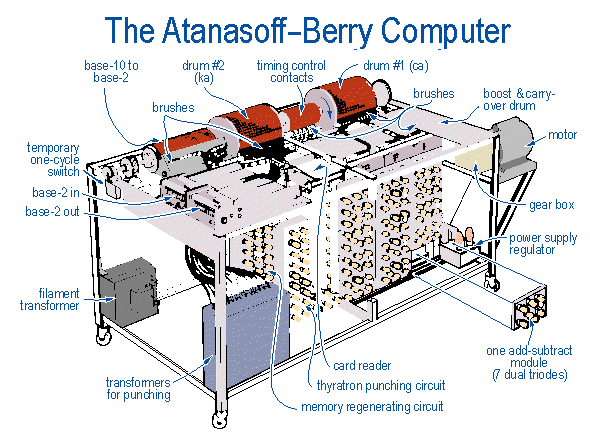
The ABC was constructed as a special-purpose electronic calculator for systems of linear equations. Its principal technical features included:
- Use of binary arithmetic rather than decimal representation for internal calculation.
- Electronic switching elements (vacuum tubes) to perform arithmetic steps faster than electromechanical devices of the time.
- Regenerative capacitor-based storage for intermediate values, an early form of electronic memory.
- Implementation of a programmed mathematical procedure (Gaussian elimination) in hardware rather than as a stored program.
Significance and legacy
Although not programmable and intended for a narrow task, the ABC introduced ideas that later appeared in general-purpose digital computers: binary representation, electronic components for logic, and separation of storage and computation. In later decades the ABC was recognized by historians and in a 1970s court decision as an important predecessor to other electronic computers. Physical reconstructions and museum exhibits help preserve its story for the public.
Further notes and resources
The ABC illustrates how focused engineering problems can drive conceptual advances in computing. For concise technical summaries and historical context, see contemporary overviews and museum descriptions: overview and timeline and museum materials and reconstructions.
Related articles
Author
AlegsaOnline.com Atanasoff–Berry Computer Leandro Alegsa
URL: https://en.alegsaonline.com/art/6889