
Atlas V: ULA’s Modular Expendable Launch Vehicle
Atlas V is a family of expendable launch vehicles used to place payloads into orbit. Developed from earlier Atlas designs, it is known for a modular configuration, Russian RD-180 first stage, and Centaur upper stage.
Overview
The Atlas V is an American expendable orbital launch vehicle designed to deliver spacecraft and satellites to a wide range of orbits. Operated by the United Launch Alliance (a joint venture of Boeing and Lockheed Martin), the Atlas V has supported government, commercial and scientific missions since its first flight in 2002. It is not reusable: each flight uses a new vehicle rather than recovering stages as in some other programs, making it a conventional expendable rocket.
Image gallery
10 Images


Design and main components
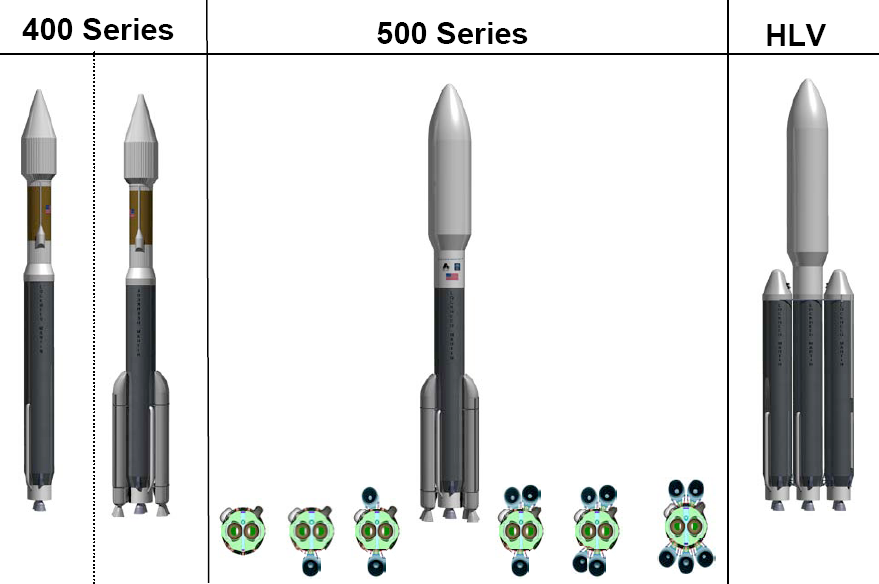
Atlas V’s architecture centers on a single-core first stage known as the Common Core Booster (CCB). That booster is powered by a Russian-built RD-180 engine, a two-chamber kerosene/liquid-oxygen engine. Above the first stage sits the Centaur upper stage, a cryogenic stage that typically uses one or two RL10 engines to place payloads precisely into their target orbit. A payload fairing protects the spacecraft during ascent; Atlas V commonly uses either a 4- or 5-meter diameter fairing covering the payload until fairing separation.
Configurations and flexibility
One of the vehicle’s defining features is its modular configuration system. A three-digit code (for example, 401 or 551) describes the vehicle: the first digit denotes the fairing diameter (4 or 5 meters), the second the number of solid rocket boosters added to the first stage for extra lift, and the third the number of Centaur engines (one or two). This modularity lets mission planners tailor performance for payload mass and orbital destination.
History and development
The Atlas V traces its lineage to earlier Atlas rockets and missiles; its design is an evolution of the Atlas family rather than a wholly new concept, inheriting lessons in reliability and staging from earlier vehicles including the original Atlas (missile). The Atlas V team first launched the vehicle in August 2002. The system later became one of the principal launch platforms for U.S. civil and national security payloads, sitting alongside other launchers from the same company and competitors.
Uses, notable missions and distinctions
Atlas V has launched a broad mix of payloads: commercial communications satellites, military and reconnaissance spacecraft, and high-profile scientific missions. Notable examples include planetary and interplanetary probes and flagship NASA missions that required the Atlas V’s reliability and performance. Unlike the NASA Space Shuttle, which was partly reusable and carried crew, Atlas V is dedicated to delivering uncrewed payloads and is discarded after ascent. It has become known for mission flexibility and for supporting precise orbital insertions that many scientific probes require.
Legacy and transition
Over time, Atlas V’s role has evolved as new launch systems are introduced. Its use of the RD-180 engine led to policy discussions about engine sourcing, and the industry has been transitioning toward next-generation vehicles. Nevertheless, Atlas V established a track record of dependable service for a wide variety of customers and remains an important chapter in modern orbital launch history. For more technical specifics and mission lists see the vehicle documentation and launch manifest resources: orbital launch vehicle, satellites.
Questions and answers
Q: What is Atlas V?
A: Atlas V is an orbital launch vehicle used by the United Launch Alliance (made of two companies, Boeing and Lockheed Martin) to place satellites into orbit.
Q: How tall and wide is Atlas V?
A: Atlas V is 58.3 metres (191 feet) tall, and 3.81 metres (12.5 feet) wide.
Q: When was its first flight?
A: Its first flight was on August 21, 2002.
Q: Is it related to the Space Shuttle?
A: No, unlike the Space Shuttle, Atlas V is only used once with a new rocket being built for each flight.
Q: What does the first stage of Atlas V consist of?
A: The first stage consists of a Common Core Booster with an RD-180 engine from Russia. Every Atlas V has this as the first stage.
Q: What does the second stage consist of?
A: The second stage is called Centaur and has one/two RL-10 engines from Aerojet Rocketdyne.
Q: Does it have a fairing covering during launch?
A Yes, on top there is a 4–5-metre (13–16-foot) wide fairing covering the spacecraft during launch
Related articles
Author
AlegsaOnline.com Atlas V: ULA’s Modular Expendable Launch Vehicle Leandro Alegsa
URL: https://en.alegsaonline.com/art/7018
Sources
- space.skyrocket.de : Gunter's Space Page – Atlas V (401) · webcitation.org
- rocket.com : "Atlas V Solid Rocket Motor" · web.archive.org
- spacelaunchreport.com : "Space Launch Report: Atlas 5 Data Sheet"