
Melodica: portable free‑reed keyboard instrument
A compact wind instrument with a built‑board and mouthpiece. The melodica combines keyboard fingering with breath control, used in education, popular music, and folk traditions worldwide.
Overview
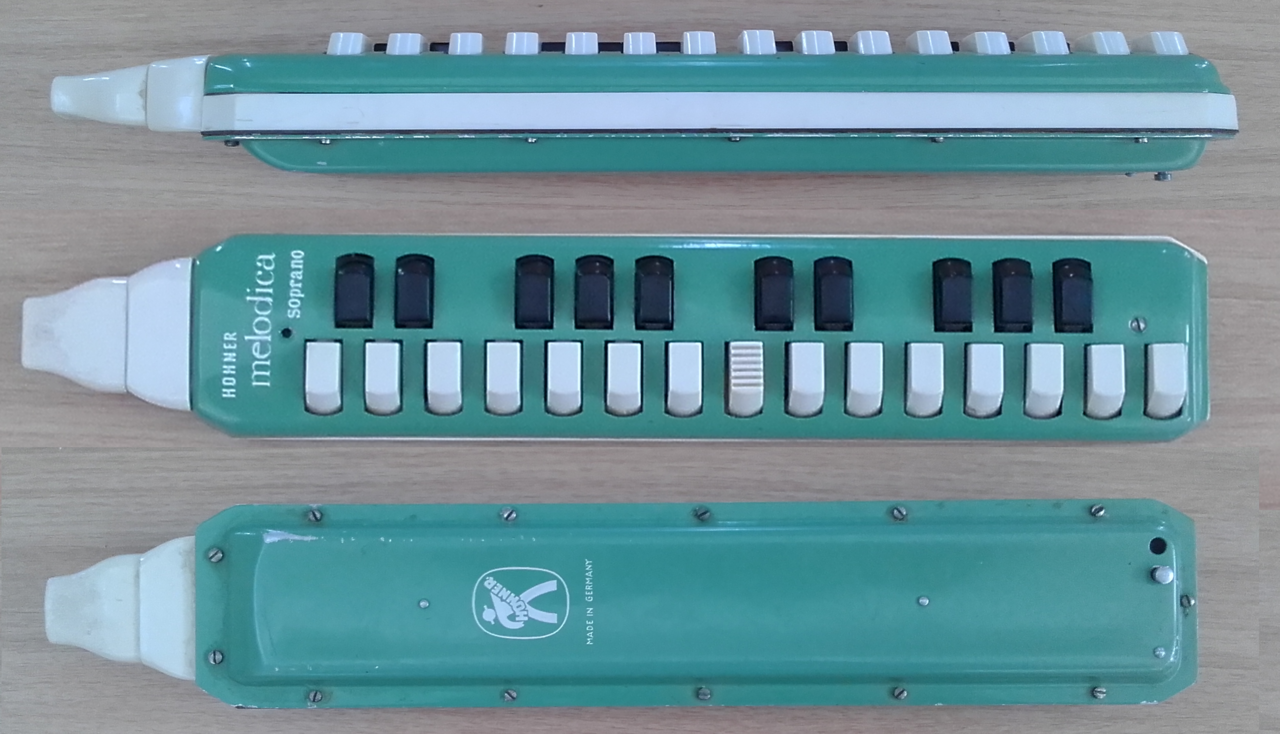
The melodica is a small, portable free‑reed instrument with a piano-style keyboard mounted on a hollow body. Sound is produced when the player blows or exhales air into a mouthpiece and depresses keys to open reeds; this combination gives the melodica elements of both wind and keyboard instruments. It is sometimes called a "blow‑organ" or "key‑flute" in informal contexts: blow‑organ, key‑flute. Typical models offer roughly two or three octaves of range: two‑ or three‑octave varieties are common.
Image gallery
10 Images



Construction and sound
Internally the melodica uses metal free reeds similar to those found in harmonicas and accordions. The keyboard opens valves that route air across selected reeds, so the instrument can play single notes, simple polyphony, or chords. Bodies are most often made from molded plastic today, though older and custom versions may use wood or metal components. Mouthpieces vary: a straight mouthpiece allows direct playing, while a flexible tube enables two‑handed keyboard technique and different tonal control.
How it is played
Playing technique resembles piano fingering combined with wind‑instrument breath control. Dynamics and phrasing depend on air pressure; short bursts, sustained tones, and subtle vibrato can be created by changing airflow or using the mouth and tongue. When using a tube, the instrument can rest on a surface so both hands are free to play more complex passages. Amplification is possible with microphones, pickups, or by routing the sound into electronic effects.
History and cultural use
Developed in the mid‑20th century as an inexpensive and easy‑to‑learn instrument, the melodica became widely adopted in school music programs and community education. It achieved notable presence in popular music: reggae and dub artists used it as a melodic lead instrument beginning in the 1970s, helping to raise its profile outside classrooms. Manufacturers such as Hohner and Yamaha produced many mass‑market models, contributing to its global spread, especially in parts of Asia where classroom use is common.
Applications and notable characteristics
- Education: favored for teaching basic keyboard and breath control simultaneously.
- Performance: used in reggae, folk, jazz, and pop for its distinct reedy tone.
- Portability: lightweight and inexpensive compared with most keyboard instruments.
- Versatility: available in different ranges and with accessories like tubes and cases.
Maintenance and variants
Basic upkeep includes keeping the body dry, replacing mouthpieces, and occasionally cleaning or tuning reeds if accessible. Variants include soprano, alto, and bass ranges, as well as models with built‑in microphones or electronic amplification. While compact and simple to start on, skilled players can use the melodica for expressive solos and complex arrangements, bridging the tactile layout of a keyboard with the breath sensitivity of wind instruments.
For further reading on instrument types and educational approaches see instrument guides and manufacturer resources like product pages or range comparisons at overview sites.
Questions and answers
Q: What is a melodica?
A: A melodica is a wind instrument with a keyboard on top, played by blowing air through a mouthpiece that fits into a hole in the side of the instrument.
Q: What are some other names for a melodica?
A: Other names for a melodica include "blow-organ" and "key-flute."
Q: How many octaves is the keyboard of a typical melodica?
A: The keyboard of a typical melodica is usually two or three octaves long.
Q: What are some features of a melodica?
A: Melodicas are small, light, and portable.
Q: What is the popularity of melodicas in music education?
A: Melodicas are popular in music education, particularly in Asia.
Q: How is a melodica played?
A: A melodica is played by blowing air through a mouthpiece that fits into a hole in the side of the instrument while pressing the keys on the keyboard.
Q: What is the playing mechanism of a melodica?
A: The playing mechanism of a melodica is similar to that of a keyboard instrument, in which pressing the keys opens and closes valves, allowing air from the player's breath to flow through reeds and produce sound.
Related articles
Author
AlegsaOnline.com Melodica: portable free‑reed keyboard instrument Leandro Alegsa
URL: https://en.alegsaonline.com/art/63684