
Melastomataceae — the melastome family of flowering plants
Melastomataceae is a large tropical family of flowering plants (about 200 genera, 4,000 species) notable for distinctive leaf venation, poricidal anthers, and many ornamental and ecological roles.
Melastomataceae is a diverse family of flowering plants placed within the order Myrtales. It includes roughly 200 genera and about 4,000 described species, primarily shrubs, small trees and herbaceous plants widely known as melastomes. The family is one of the larger clades of tropical angiosperms and is especially prominent in the New World tropics.
Image gallery
3 Images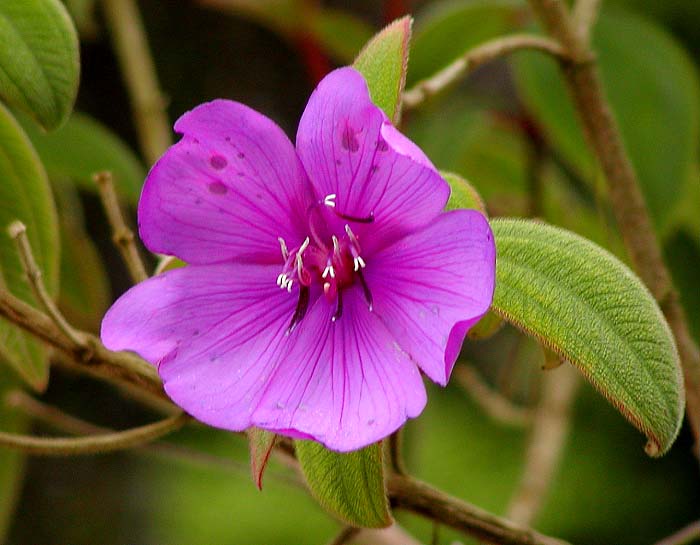

Key characteristics
Members of the family share several recognizable features that aid identification:
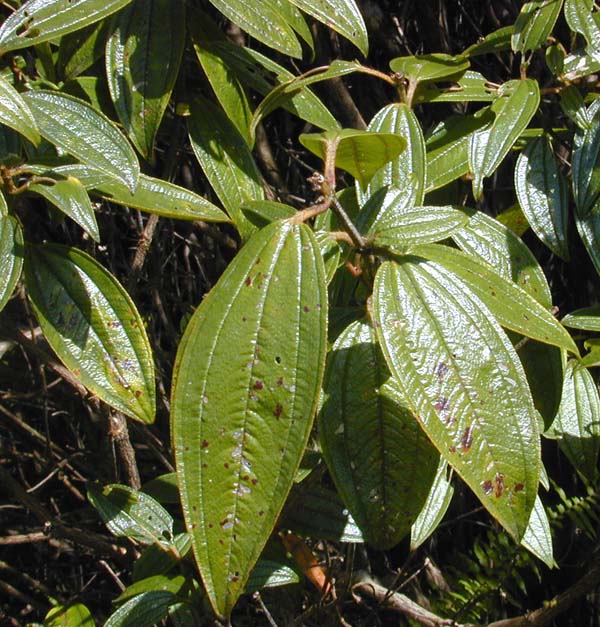
- Leaves: opposite or verticillate leaves with strong, parallel tertiary veins (acrodromous venation) radiating from the base.
- Flowers: usually actinomorphic, with 4–5 petals and a matching number of sepals; stamens are often numerous or modified and may show distinct shapes within a single flower.
- Anthers: many species have anthers that release pollen through apical pores or slits (poricidal dehiscence), a trait associated with buzz pollination by bees.
- Fruits and seeds: fruits are capsules or berries; seeds may be small and numerous or larger in fleshy fruits adapted for bird dispersal.
Distribution and habitat
Melastomataceae is predominantly tropical, with a strong center of diversity in the Neotropics but also well represented in Africa, Madagascar, Southeast Asia and the Pacific. Species occupy a range of habitats from lowland rainforests and montane cloud forests to savanna margins and disturbed ground; some are common understory shrubs, others form conspicuous flowering shrubs or small trees.
Ecology, pollination and uses
Ecologically important for tropical ecosystems, melastomes interact with many pollinators and frugivores. The poricidal anthers in many genera require bee species capable of vibration (buzz pollination) to extract pollen. Several species produce fleshy fruits eaten by birds and mammals, aiding seed dispersal. Economically, a number of species are cultivated as ornamental plants (for example, purple-flowered Tibouchina), while others have local uses in traditional medicine or horticulture.
Taxonomy and notable genera
The family contains numerous genera of various sizes; well-known examples include Miconia, a very large Neotropical genus; Tibouchina, popular in cultivation for showy flowers; Melastoma, found in Asia and Australasia; Rhexia, native to North American wetlands; and Medinilla, ornamentals from Southeast Asia. Ongoing botanical research and molecular studies continue to refine relationships within the family and its placement in current classifications.
Because of their distinctive morphology and ecological roles, melastomes are of interest to botanists, ecologists and horticulturists alike. Field identification commonly relies on leaf venation and floral structure, while conservation attention focuses on habitat loss in biodiverse tropical regions.
Related articles
Author
AlegsaOnline.com Melastomataceae — the melastome family of flowering plants Leandro Alegsa
URL: https://en.alegsaonline.com/art/63630
Sources
- botany.hawaii.edu : "Flowering Plant Families, UH Botany"