
Maze: types, history, design, and practical uses
A maze is a puzzle built from paths and barriers. This article explains types, structure, history, differences from labyrinths, common solving methods, and practical applications in games, research, and landscape design.
A maze is a puzzle or constructed environment composed of branching paths and dead ends, designed to present a challenge of navigation or finding a goal. Mazes appear in many forms, from printed puzzles for children to large outdoor attractions. They can be traversed on foot, solved with a pencil on paper, or navigated by robots and virtual agents. The defining element of a maze is the presence of multiple choices and misleading routes rather than a single continuous path.
Image gallery
10 Images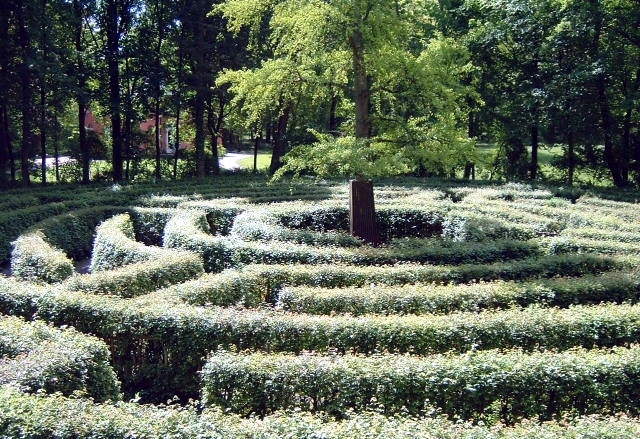


Structure and common types
Mazes are described by their topology and layout. Common categories include:
- Perfect mazes – every path connects without loops, so there is exactly one route between two points.
- Imperfect mazes – contain loops and multiple routes, allowing shortcuts or circular paths.
- Hedge and garden mazes – physical mazes built from plants, walls, or hedges, often ornamental.
- Handheld tilting mazes – small puzzles where a ball must be guided through channels by tilting.
History and cultural context
Mazes and labyrinths have ancient roots. The classical image of the labyrinth is tied to the Greek myth of the Minotaur and the Cretan labyrinth, widely referenced in art and literature. In Europe, from the Renaissance onward, hedge mazes became features of estates and public gardens. Over time, interest shifted to printed maze puzzles and mechanical or digital versions that emphasize problem solving and entertainment.
It is important to distinguish a maze from a labyrinth. A labyrinth (sometimes called unicursal) typically has a single winding path leading to a center with no branching choices; it is intended for contemplative or ritual walking rather than as a navigational puzzle.
Uses, solving methods, and notable facts
Mazes are used for recreation, education, psychological and neurological experiments, and robotics. Common human strategies for solving physical mazes include the wall-follower (keeping one hand on a wall) and mapping or backtracking approaches. Algorithms used in computing and robotics to solve or generate mazes mirror these ideas: depth-first search, breadth-first search, and procedural generation methods such as recursive backtracking or randomized growth algorithms.
Mazes remain popular because they combine spatial reasoning, pattern recognition, and sometimes aesthetic design. Seasonal corn mazes, mirror mazes, escape-room challenges, and online maze games all draw on the same basic concept: a network of choices that must be navigated to reach an objective.
Related articles
Author
AlegsaOnline.com Maze: types, history, design, and practical uses Leandro Alegsa
URL: https://en.alegsaonline.com/art/63164