
Mazandarani (Tabari): overview of the Northwestern Iranian language
Mazandarani (Tabari) is a Northwestern Iranian language spoken along Iran's southern Caspian coast, with several million speakers, distinct dialects, and a long local oral tradition.
Overview
Mazandarani, often called Tabari in local usage, is a Northwestern Iranian language spoken primarily along the southern coast of the Caspian Sea in northern Iran. Estimates commonly place the number of speakers at roughly three to four million. It is distinct from standard Persian and belongs to the broader Caspian group of Iranian languages, which also includes Gilaki. Mazandarani preserves many older Iranian features that have been lost or altered in Persian.
Image gallery
5 Images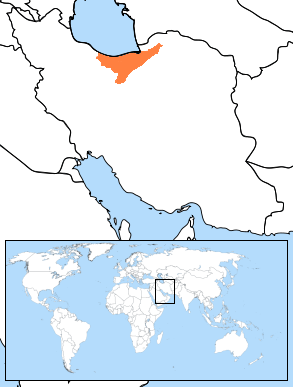



Classification and linguistic characteristics
Classified within the Northwestern branch of the Iranian family, Mazandarani shares some grammar and vocabulary with neighboring Caspian languages but is not mutually intelligible with Persian. Its phonology, verbal system, and certain core lexemes show conservative traits that reflect older stages of Iranian. The language typically uses the Perso-Arabic script when written, though there is no single standardized orthography used by all speakers.
Distribution and dialects
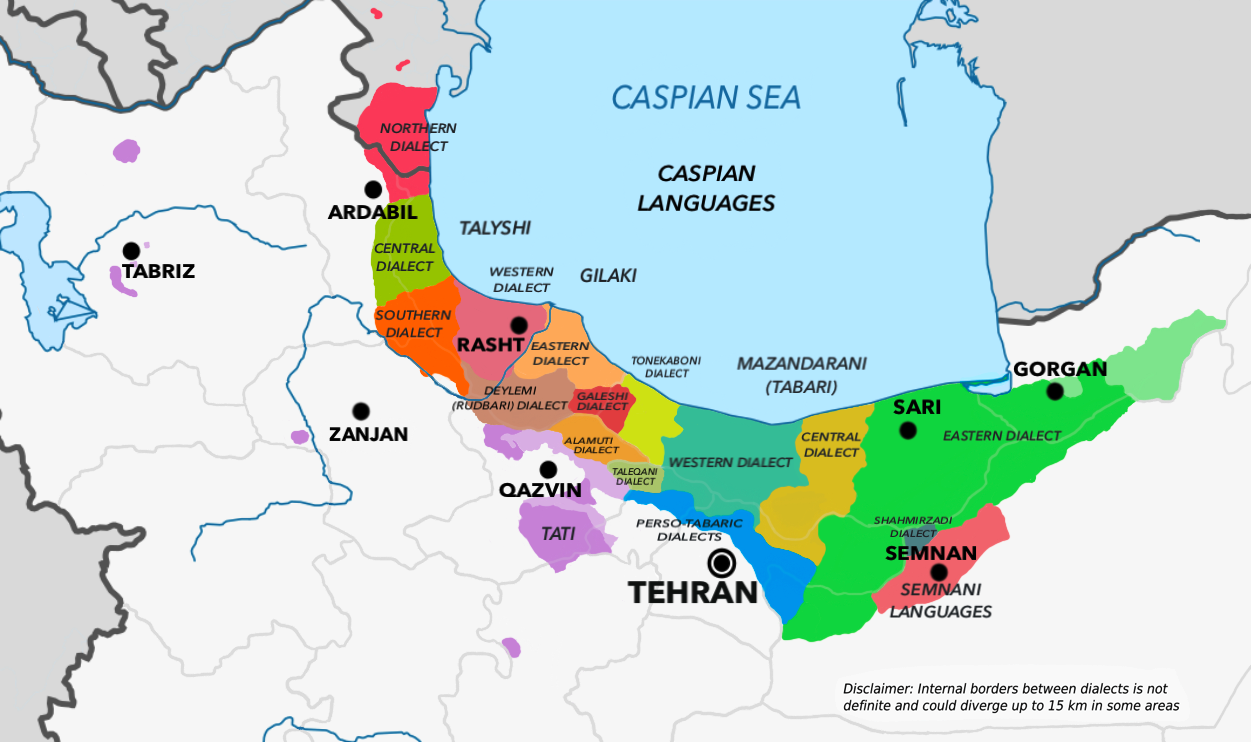
Mazandarani is concentrated in Mazandaran province and adjacent areas. It is used in rural and urban communities of the coastal plain and the nearby foothills, and pockets of speakers extend into neighboring provinces. For example, it is spoken across much of Mazandaran, in parts west of Golestan, north of Tehran such as areas around north of Tehran, and into sections of Semnan and the northeast of Qazvin. Internal variation is considerable: local dialects may differ in pronunciation, vocabulary, and some grammatical details.
History and literature
Mazandarani has deep historical roots in the region and is considered more conservative than many southwestern Iranian varieties. Although most historical written records for the region have been composed in Persian, the language has a rich oral heritage: proverbs, folktales, songs and seasonal ritual language have been important means of transmission. Occasional modern literary and scholarly works appear in Mazandarani, and researchers study its lexicon and structure to trace Iranian language developments.
Uses, status and notable facts
In daily life Mazandarani functions as a community and family language in many towns and villages, while Persian remains dominant in formal education, media and administration. This diglossic situation has led to vocabulary borrowing from Persian and partial language shift in some areas. Cultural organizations, local media, and academic projects have promoted documentation, teaching materials and recordings to support maintenance of Mazandarani. Linguistically, it is notable for its conservative elements within the Iranian family and for contributing to the cultural identity of the Caspian region.
Key features
- Northwestern Iranian (Caspian) branch affiliation.
- Significant dialectal diversity across a compact geographic area.
- Strong oral tradition: songs, tales and proverbs.
- Contemporary influence and pressure from Persian, with ongoing documentation efforts.
Questions and answers
Q: What is the Mazandarani language?
A: The Mazandarani language is an Iranian language spoken in northern Iran.
Q: In which areas is the Mazandarani language spoken?
A: The Mazandarani language is spoken in Mazandaran, west of Golestan, north of Tehran and Semnan and northeast of Qazvin.
Q: How many people speak the Mazandarani language?
A: Between 3-4 million people speak the Mazandarani language.
Q: Is the Mazandarani language a new language?
A: No, the Mazandarani language is an older Iranian language.
Q: Is the Mazandarani language spoken anywhere outside Iran?
A: No, the Mazandarani language is only spoken in Iran.
Q: Is the Mazandarani language commonly spoken in Iran?
A: Yes, the Mazandarani language is spoken by millions of people in Iran.
Q: What is another name for the Mazandarani language in Mazandarani?
A: In Mazandarani, the Mazandarani language is called "Mäzeruni".
Related articles
Author
AlegsaOnline.com Mazandarani (Tabari): overview of the Northwestern Iranian language Leandro Alegsa
URL: https://en.alegsaonline.com/art/63157