
Marriage Italian Style (Matrimonio all'italiana) — 1964 film
1964 Italian comedy-drama directed by Vittorio De Sica, starring Sophia Loren and Marcello Mastroianni. Based on Eduardo De Filippo's play, noted for performances, social themes and two Academy Award nominations.
Overview
Marriage Italian Style (Italian: Matrimonio all'italiana) is a 1964 Italian comedy-drama directed by Vittorio De Sica. The film examines a long, complicated relationship between a sharp-tongued woman and a worldly man. The role of the man — a cynical businessman — is played by Marcello Mastroianni, while the woman, a former lover who seeks recognition and security, is portrayed by Sophia Loren. The movie blends humor and melodrama to explore love, social status and marriage.
Image gallery
1 Image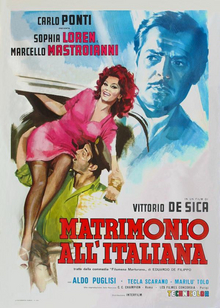
Plot and characters
The story follows a long-standing on-again, off-again affair in which the female lead attempts to secure a legitimate place in the man's life. Over the course of the film she uses wit, patience and strategic moves to confront issues of respectability, parenthood and legal recognition. The interplay between the two leads drives much of the film's emotional tension, alternating between comic confrontation and poignant moments.
Origins and production
The screenplay is adapted from a well-known stage play by Eduardo De Filippo. Vittorio De Sica, a principal figure of postwar Italian cinema, directed the film and shaped it into a cinematic study of character and social mores. De Sica's approach emphasizes performance and human detail rather than spectacle, and the adaptation preserves the play's sharp dialogue while opening scenes to the cinematic setting.
Cast, style and themes
- Lead actors: Marcello Mastroianni and Sophia Loren, whose chemistry and timing are central to the film's appeal.
- Style: A mixture of comedy and melodrama that uses everyday settings, expressive performances and economical direction.
- Themes: Marriage and social legitimacy, gender roles, economic security, and the negotiation of affection and power.
Reception and awards
The film drew attention internationally for its performances and was recognized by major awards organizations. It received nominations at the Academy Awards, including a nomination for the leading actress. Critics praised Loren's portrayal for its depth and range, and Mastroianni's performance was frequently cited for its nuanced restraint. Contemporary and later assessments often highlight the film as a notable collaboration between two of Italy's most celebrated screen actors and a prominent director.
Legacy
Over time the film has been regarded as an important example of Italian cinema from the 1960s, notable for adapting a theatrical work to screen while keeping a focus on character study. Its exploration of marriage as both personal choice and social institution continues to make it a subject of discussion in film studies and retrospectives. The film remains available through classic film programs and is frequently referenced when discussing the careers of De Sica, Loren and Mastroianni.
Questions and answers
Q: What is Marriage Italian Style?
A: Marriage Italian Style is a 1964 movie.
Q: What is the story of the movie?
A: The movie is about a cynical business man who goes through an on-off relationship.
Q: Who are the actors playing the lead roles in the movie?
A: Marcello Mastroianni plays Domenico and Sophia Loren plays Filomena.
Q: Has this movie won any Academy Awards?
A: The movie has been nominated for two Academy Awards.
Q: In which category was Sophia Loren nominated for an Academy Award for the movie?
A: In 1965, Sophia Loren was nominated for Best Actress in a Leading Role.
Q: In which category was the movie nominated for an Academy Award?
A: In 1966, the movie was nominated for Best Foreign Language Film.
Q: Why is the movie titled "Marriage Italian Style"?
A: The title of the movie suggests that it is about the concept of marriage in Italian culture. However, the story of the movie is not necessarily limited to an exploration of this theme.
Related articles
Author
AlegsaOnline.com Marriage Italian Style (Matrimonio all'italiana) — 1964 film Leandro Alegsa
URL: https://en.alegsaonline.com/art/62225