
Arrondissement of Die (Drôme, Auvergne-Rhône-Alpes)
Administrative arrondissement in southeastern France centered on the subprefecture of Die; a largely rural area of valleys, plateaus and mountains noted for agriculture, outdoor recreation and local wines.
Overview
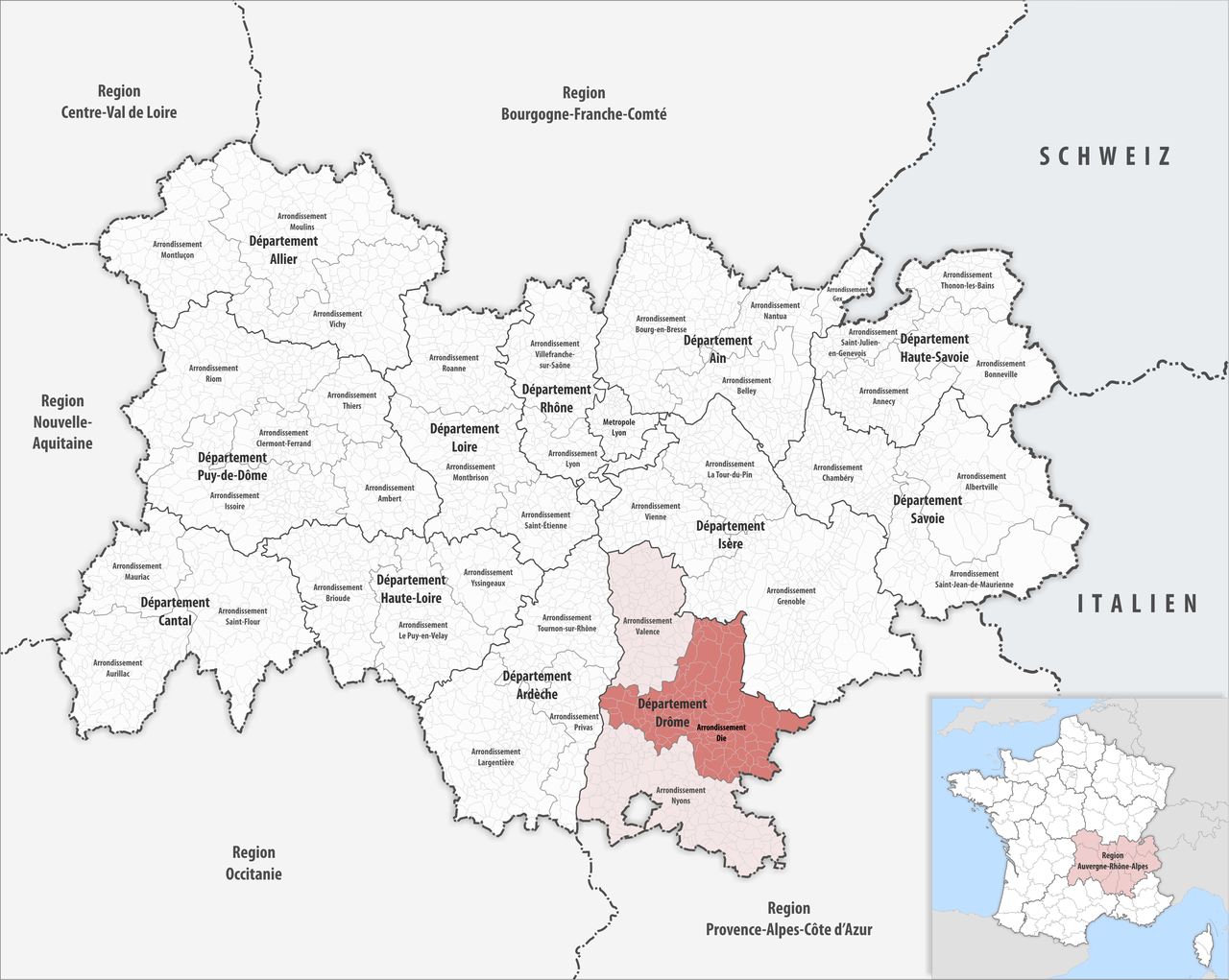
The arrondissement of Die is an administrative district in southeastern France, located within the Drôme département and the Auvergne-Rhône-Alpes region. Its administrative seat and principal town is the city commonly called Die, which functions as the subprefecture or capital for the arrondissement. In the French system, an arrondissement groups communes for state administration and statistical purposes.
Image gallery
2 Images
Geography and landscape
The territory covers a varied landscape of river valleys, limestone plateaus and mountain foothills. It lies on the eastern edge of the Massif Central and borders the Vercors massif and other highlands, producing a mix of continental and Mediterranean climatic influences. Settlements range from small rural villages to larger market towns, with agricultural land, forested zones and upland pastures prominent across the area.
History and administration
Arrondissements as a unit were established during the reorganisation of French territorial administration in the early 19th century; the arrondissement of Die has evolved within that framework and today serves as an intermediary level between the department and the communes. It comprises numerous communes, each with its own municipal council, while the subprefecture represents the national government at local level for coordination and public services.
Economy and uses
The economy is largely rural and diversified: traditional agriculture and viticulture coexist with artisanal production and small-scale industry. The area is known for local wines—particularly sparkling and other specialty wines produced around Die—and for products tied to its mountain and valley environments. Tourism is important, with hiking, climbing, cycling and winter sports attracting visitors to natural sites and regional parks.
Notable features and distinctions
Visitors and researchers note the arrondissement's combination of natural scenery, rural heritage and historical architecture, including Romanesque churches and vestiges of medieval settlement. Conservation efforts in nearby natural areas emphasize biodiversity and sustainable tourism. Its low population density compared with urban centers gives the territory a predominantly pastoral character.
Practical information
As an administrative unit, the arrondissement is relevant for public administration, statistical reporting and regional planning. For more detailed maps, demographics and official services consult departmental or regional resources via local administrative portals and guides. Additional information can be found through regional cultural and tourism offices and official departmental pages.
Related links: arrondissement, Drôme, département, Auvergne-Rhône-Alpes, region, capital, Die.
Related articles
Author
AlegsaOnline.com Arrondissement of Die (Drôme, Auvergne-Rhône-Alpes) Leandro Alegsa
URL: https://en.alegsaonline.com/art/5942
Sources
- splaf.free.fr : "Historique de la Drôme"
- insee.fr : "Arrondissement de Die (261)"
- insee.fr : "Régions, départements, arrondissements, cantons et communes"
- insee.fr : "Département de la Drôme (26)"
- insee.fr : "Arrondissement de Die (261)"
- tools.wmflabs.org : 44°45′15″N 5°22′10″E / 44.75417°N 5.36944°E / 44.75417; 5.36944