
Argus As 014 pulsejet engine
The Argus As 014 was a simple pulsejet engine developed in Germany and used to power the V-1 flying bomb. It is known for its low cost, rudimentary construction and distinctive pulsing exhaust.
Overview
The Argus As 014 was a pulsejet propulsion unit developed in Germany in the late 1930s and put into mass use during World War II. It became most widely known as the powerplant of the V-1 flying bomb, where it provided a straightforward and inexpensive means of producing sustained thrust. The As 014 exemplifies a class of engines that produce thrust by repeated combustion pulses rather than by continuous airflow through turbines.
Image gallery
7 Images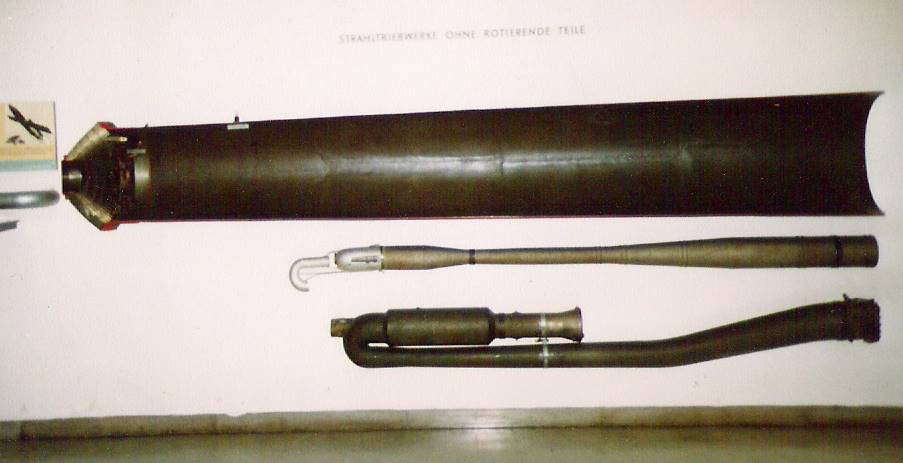




Design and operation
Unlike the contemporary turbojet, the As 014 used intermittent combustion. Air and fuel entered a combustion chamber through a valve grid at the front; a mixture ignited and expanded, producing a high-pressure exhaust pulse out the rear tailpipe. After each combustion event the front valves closed, the pressure fell, fresh air and fuel were drawn in, and the cycle repeated at a rapid rate. The engine therefore had few moving parts — principally the shutter-like valve assembly at the intake — and relied on the acoustical resonance of the tube to sustain the pulse rhythm.
Construction and characteristics
The unit was deliberately simple to manufacture. Components could be formed from rolled and welded sheet steel, with a basic fuel system and an igniter used for startup. Its advantages were low cost, ease of production and relatively low manufacturing skill requirements. Drawbacks included loud operation, poor fuel efficiency compared with turbojets, limited altitude performance and substantial vibration and structural stresses that limited service life.
History and operational use
Production of the As 014 increased rapidly once it was selected for the V-1 flying bomb, a small pilotless weapon intended for long-range attacks. The engine’s minimal complexity enabled large-scale manufacture under wartime constraints. There were also proposals and studies late in the war to adapt pulsejet propulsion for very low-cost, expendable or emergency combat aircraft, but these ideas were largely overtaken by faster, more efficient jet technologies.
Legacy and distinctions
The Argus As 014 remains notable as a practical example of pulsejet technology and for its role in one of the first operational cruise missiles. Its simple construction and audible exhaust pulses made it distinctive; it also highlighted the trade-offs between simplicity and performance that distinguish pulsejets from turbojets and ramjets. For readers seeking a technical summary see technical descriptions, and for context on the weapon that used it see the V-1 entry at the V-1 flying bomb.
Tags
Related articles
Author
AlegsaOnline.com Argus As 014 pulsejet engine Leandro Alegsa
URL: https://en.alegsaonline.com/art/5511