
Kingdom of Armenia
Overview of the several historical Armenian kingdoms: the ancient Artaxiad/Arsacid polity, the medieval Bagratid state, and the later Armenian Kingdom of Cilicia, plus their culture, politics and legacy.
The phrase "Kingdom of Armenia" refers to a succession of Armenian states that arose at different times in and around the Armenian Highlands. These polities played a central role in the politics of the Near East by acting as cultural centers, Christian pioneers, and strategic border realms between larger empires. Though sometimes spoken of as a single continuous entity, the Armenian kingships were distinct in dynasty, territory and political orientation.
Image gallery
1 Image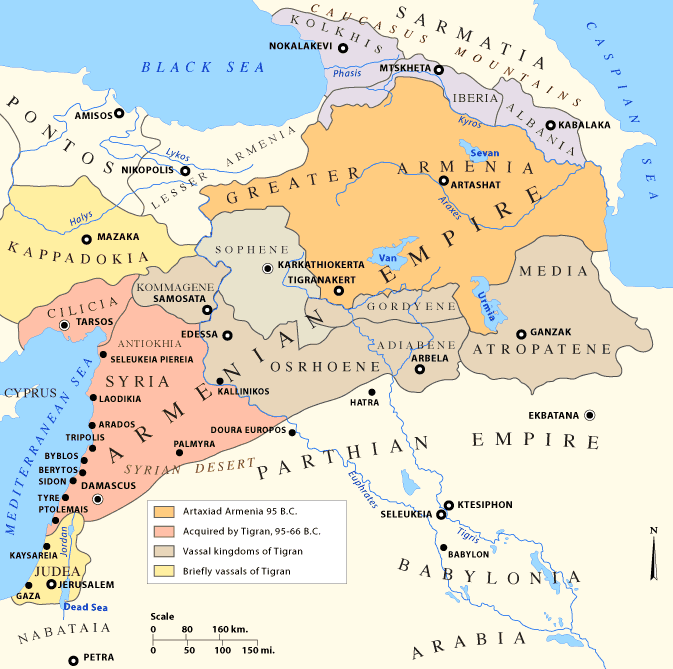
Principal medieval and ancient kingdoms
- Kingdom of Armenia (Antiquity): dynasties commonly grouped under this label include the Artaxiad and later Arsacid houses (roughly from the 2nd century BC to the late 4th–early 5th century AD).
- Bagratid Kingdom of Armenia (Middle Ages): an independent Armenian monarchy centered on the city of Ani that flourished in the 9th–11th centuries (commonly dated c. 885–1045).
- Armenian Kingdom of Cilicia: a Late Medieval Armenian state on the southern coast of Anatolia (generally 12th–14th centuries), often called Cilician Armenia and known for close contacts with Crusader and European polities.
In antiquity the Artaxiad dynasty produced powerful rulers such as Tigranes the Great, who expanded Armenian influence across the Near East in the 1st century BC. Over time Armenian rulers negotiated with Rome, Parthia and later Sasanian Persia; these shifting alignments shaped internal administration and culture. By the late fourth and early fifth centuries Armenia had been partitioned and its native monarchy reduced or abolished under pressure from Rome/Byzantium and the Sasanian state.
The medieval Bagratid restoration reestablished a native Armenian royal house after centuries of foreign domination. The Bagratuni kings developed prosperous urban centers—Ani became renowned for its churches and monumental architecture—and the kingdom supported a literary and ecclesiastical revival. The Bagratid realm eventually succumbed to Byzantine expansion and internal fragmentation in the eleventh century.
When Armenians established a coastal kingdom in Cilicia they created a polity that combined Armenian traditions with Latin and Frankish influences. The rulers of Cilicia engaged diplomatically and militarily with Crusader states, Byzantine and Mongol powers, adopting some Western feudal practices while remaining distinct in language and church affiliation. Cilician Armenia survived until the late 14th century, when rising regional powers overwhelmed it.
Cultural and religious achievements are important parts of these kingdoms' legacy. Armenia is traditionally cited as the first state to adopt Christianity as its official religion (traditionally dated to the early fourth century), and the invention of the Armenian alphabet by Mesrop Mashtots in the early fifth century was decisive for the preservation of Armenian literature, liturgy and identity. The Armenian Apostolic Church and a rich architectural and manuscript tradition emerged from the royal courts and monastic centers of these kingdoms.
Historically the various Armenian kingdoms are best understood as related but separate phases: an ancient empire-like kingdom in the classical era, a medieval high-medieval Bagratid state on the Armenian plateau, and a later Cilician kingdom on the Mediterranean coast. Together they shaped the language, religion and cultural continuity that underpin Armenian identity up to the present day, and their monuments and manuscripts remain primary sources for the study of the region’s medieval history.
Related articles
Author
AlegsaOnline.com Kingdom of Armenia Leandro Alegsa
URL: https://en.alegsaonline.com/art/53587