
King of the Congo (serial)
King of the Congo is a 1952 Columbia Pictures jungle-adventure film serial starring Buster Crabbe as Thun'da, adapted from Frank Frazetta's comic creation; notable as a late-era Tarzan-style serial.
Overview
King of the Congo is a jungle-adventure film serial produced by Columbia Pictures and released in the early 1950s. The serial stars Buster Crabbe as the lead character Thun'da, the wilderness hero whose everyday identity is Capt. Roger Drum. The story was adapted from a comic-book hero created by artist Frank Frazetta, and the serial is often remembered as a late example of the Tarzan-style genre that had been popular in earlier decades.
Image gallery
1 Image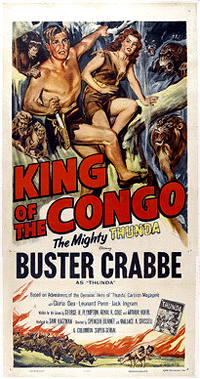
Format and characteristics
As a theatrical serial, King of the Congo was made in multiple short chapters designed to be shown in weekly installments. Like other serials of the era, it relied on action set pieces, exotic jungle settings, recurring antagonists and cliffhanger endings to encourage audiences to return. Production values reflected modest studio budgets typical of serials, with economical sets, stock footage of animals, and straightforward stunt work.
Source material and creators
The title character traces to the comic-page adventures drawn by Frank Frazetta, who later gained renown as a fantasy illustrator. The adaptation translated the pulp-style visuals and macho hero archetype into live-action episodic installments. Columbia Pictures, the distributing studio, had an extensive history of serial production and positioned this project within the continuing public appetite for adventure stories even as tastes were shifting toward television.
Plot elements and cast
Without detailing every episode, the serial follows Thun'da/Capt. Roger Drum as he confronts hostile forces in an African jungle environment: marauding villains, tribal politics, hazardous wildlife and hidden ruins are among the recurring obstacles. Buster Crabbe, already well known for earlier serial roles, anchors the production with a physical, stunt-oriented performance. The serial format emphasizes episodic peril and rescue more than psychological depth.
Historical context and significance
King of the Congo occupies a transitional place in American popular cinema. It is often cited as one of the last of the Tarzan-style serials produced for movie theaters and marks the end of Crabbe's long career in serials; he had been a familiar face in the form since the 1930s. The decline of theatrical serials in the 1950s was driven in part by the rise of television and changing audience habits, so late entries like this are viewed by historians as representative of a fading format.
Notable facts and legacy
- The lead is portrayed by Buster Crabbe, whose serial career included other adventure heroes.
- The character originates from a comic by Frank Frazetta, a figure later celebrated for fantasy art; background on the comic can be found via comic-book sources.
- The serial exemplifies influences from iconic jungle figures such as Tarzan, while remaining a distinct pulp adaptation.
Today, King of the Congo is of interest to collectors, genre enthusiasts and scholars studying the transition of popular entertainment from theatrical serials to television-era formats. It showcases the production methods, narrative strategies and star-driven marketing typical of mid-century American serial filmmaking.
Related articles
Author
AlegsaOnline.com King of the Congo (serial) Leandro Alegsa
URL: https://en.alegsaonline.com/art/53563