
King Ghidorah — three-headed kaiju from the Godzilla series
King Ghidorah is a recurring three-headed dragon kaiju from Toho's Godzilla films, known for golden scales, gravity/energy attacks, flight, and status as Godzilla's most iconic adversary and occasional ally.
Overview
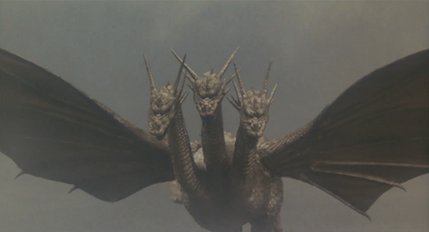
King Ghidorah is a prominent fictional monster originating in mid-20th-century Japanese genre cinema. Often depicted as a winged, three-headed dragon with two tails and no forelimbs, he is typically portrayed with metallic or golden scales and the ability to fly. Ghidorah has appeared repeatedly as a central antagonist in films featuring Godzilla and other kaiju, and his image is one of the most recognizable in the genre.
Image gallery
7 Images


Appearance and abilities
Designs for King Ghidorah have varied between productions, but standard characteristics include three independent heads, a pair of large bat-like wings, two tails, and an imposing, serpentine body. His signature powers are often shown as long-range energy attacks fired from his mouths; these are sometimes described as gravity beams, lightning bolts, or destructive energy lances. Other recurring traits include rapid flight, great physical strength, remarkable resilience or regenerative ability, and, in some stories, a degree of intelligence or telepathic control.
History and development
Created by Toho Studios for the 1960s era of monster films, King Ghidorah first appeared as a major cinematic threat and subsequently returned in multiple sequels and reimaginings. Over the decades filmmakers have updated his origin and role: he has been presented as an extraterrestrial invader, a bioengineered weapon, and a near-mythic force of nature depending on the story. Each production brought changes to costume, special effects, and scale—moving from practical suits and miniatures to modern visual effects in later adaptations.
Notable appearances
Ghidorah is a staple of the Godzilla cycle and also appears in crossover events, ensemble monster films, and international adaptations. In some English-language releases he has been called "Monster Zero" or simply "Ghidorah." The character was reinterpreted for contemporary audiences in recent big-budget films, where updated effects emphasized aerial combat and energy-based attacks while preserving the multi-headed silhouette that defines him.
Significance and distinctions
- Symbolic role: Ghidorah often functions as an external, apocalyptic threat—an embodiment of overwhelming power against which other monsters may temporarily unite.
- Design evolution: Different eras (classic, modern, and rebooted cinema) have altered his scale, color, and abilities to match contemporary effects and narrative goals.
- Popular impact: His three-headed form and rivalry with Godzilla have made him one of the most enduring and frequently referenced creatures in kaiju media.
For further reading on genre history and character variations, consult general resources on kaiju cinema and film encyclopedias. Additional entries explore his many film incarnations and the visual effects techniques used to realize them across different decades. See also: Japanese film overviews and retrospectives, and comparative pages on Godzilla and other franchise monsters. Other contextual materials may be found under entries for golden mythic creatures and the motif of the three-headed dragon.
Related articles
Author
AlegsaOnline.com King Ghidorah — three-headed kaiju from the Godzilla series Leandro Alegsa
URL: https://en.alegsaonline.com/art/53543