
Killer Joe (2011 film)
2011 crime dark comedy film directed by William Friedkin, adapted from Tracy Letts's play. Noted for strong performances, violent content and an NC-17 rating controversy.
Overview
Killer Joe is a 2011 American crime dark-comedy film directed by William Friedkin and adapted from the play by Tracy Letts. The plot centers on a desperate young man who hires a police detective-turned-hitman to kill his mother for insurance money; the arrangement unravels into a tense and violently charged series of confrontations. The film blends black humor with brutal realism, testing audience tolerance for on-screen violence and transgressive behavior. It features a notable supporting performance by Gina Gershon.
Image gallery
1 Image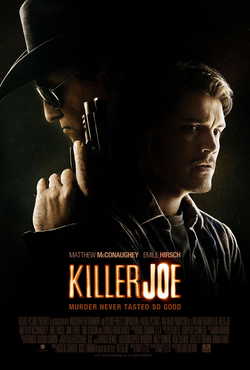
Plot elements and themes
At its core the film is a domestic crime story that explores family dysfunction, poverty, and moral decay. Characters move from petty criminality to life-threatening extremes as loyalties and motives shift. The narrative uses bleak humor and exaggerated character types to comment on desperation and the commodification of human life, often forcing viewers to confront uncomfortable ethical choices. The storyline has been described as a mixture of genre elements—crime thriller, black comedy and stage drama—creating an intentionally abrasive tone that some audiences find compelling and others find disturbing. For a concise description of the central story, critics often point to its fusion of grim motives with theatrical confrontation.
Cast and characters
- Matthew McConaughey as the titular hitman, often called Killer Joe.
- Emile Hirsch in the role of the young man who hires the killer.
- Juno Temple as a conflicted younger woman caught up in the scheme.
- Thomas Haden Church as a family member whose choices fuel the plot.
- Gina Gershon in a provocative and divisive supporting role.
This ensemble mixes actors known for both mainstream work and risk-taking indie roles, contributing to a charged, theatrical performance style that reflects the story’s stage origins.
Production, release and rating controversy
The film was produced as a feature adaptation of a stage play and was released in the United States by LD Entertainment. Upon submission to the Motion Picture Association, it received an NC-17 rating for explicit violent and sexual content, including a scene that many viewers and the MPAA described as particularly graphic. The distributor appealed the classification in an attempt to secure an R rating for broader commercial release but the appeal did not succeed. The NC-17 rating became a prominent part of the film’s public discussion and influenced marketing and exhibition decisions.
Reception and legacy
Critical response was mixed to positive: some reviewers praised the performances and Friedkin’s uncompromising direction, while others criticized the film’s use of shock and its bleak depiction of human behavior. The movie’s controversial elements—especially the sequence that precipitated the rating decision—have been the subject of debate about censorship, artistic freedom, and audience limits. As an adaptation of a widely produced play, the film is often discussed alongside theatrical productions for its remaining theatricality and stage-derived intensity.
Notable facts and distinctions
- The film is a rare mainstream feature in the 2010s to be released with an NC-17 rating, which affected its distribution and promotion.
- It is based on a play by Tracy Letts, which has been staged in multiple productions and is known for its dark humor.
- The narrative hinges on a murder-for-hire premise and family betrayal—specifically a plot to have a mother killed for financial gain—an element often described in brief as the plan to have the family matriarch "taken out" (murder-for-hire plot).
- Wider conversations about the film have touched on the relationship between stage adaptation and cinematic realism, and on how ratings shape which films are widely seen.
For readers seeking information on the film’s cast, production notes and broader discussion, industry pages and reviews provide detailed coverage of the performances, the director’s approach, and the controversy that accompanied the film’s release. The movie occupies a distinct place as a polarizing example of black comedy that deliberately courts discomfort to make thematic points.
For additional context on performers and production, see cast listings and distribution notes: genre commentary and reviews and contemporary reporting on the appeal process to the ratings board.
Related articles
Author
AlegsaOnline.com Killer Joe (2011 film) Leandro Alegsa
URL: https://en.alegsaonline.com/art/53399