
János Bolyai: Pioneer of Non-Euclidean Geometry
János Bolyai (1802–1860) was a Hungarian mathematician who produced an independent development of non-Euclidean geometry and published a famous 1832 appendix that changed geometry's foundations.
János Bolyai (1802–1860) was a Hungarian mathematician best known for his early and independent formulation of a consistent geometry in which Euclid's parallel postulate does not hold. His work demonstrated that alternative, logically coherent geometries exist and helped reshape the foundations of mathematics in the 19th century.
Image gallery
10 Images


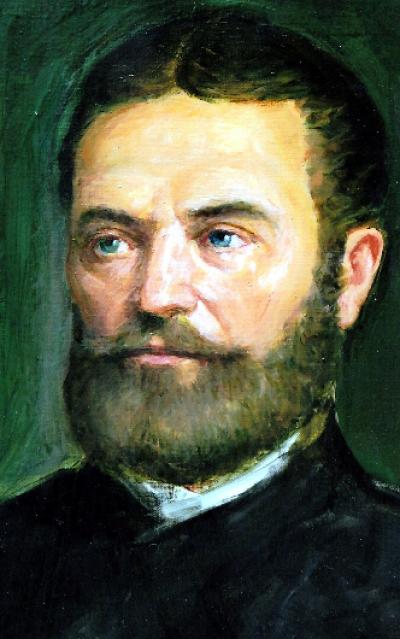


Life and background
Bolyai was born into a family with strong mathematical interests and received a rigorous education for his time. He served as an officer in the Austrian army for part of his life, but remained engaged with mathematical questions. His father, also a mathematician, encouraged study but reportedly discouraged fruitless attempts to resolve the parallel postulate — an attitude that makes the younger Bolyai's achievement more striking.
Major work and ideas
In 1832 Bolyai published an "Appendix" as part of another volume; this short work set out the principles of a geometry in which many familiar Euclidean results hold but parallel lines behave differently. He argued that the parallel postulate is independent of Euclid's other axioms and developed consequences of replacing it — a form of what is now called non-Euclidean geometry.
- He arrived at conclusions similar to those later publicized by others, notably Nikolai Lobachevsky, but did so independently.
- Carl Friedrich Gauss, in private correspondence, acknowledged the importance of Bolyai's results and suggested he had reached related ideas earlier without publishing them.
- Bolyai's appendix is concise but conceptually powerful: it showed that alternatives to Euclid were not self-contradictory.
Importance and legacy
Bolyai's contribution helped clear the way for modern geometry, influencing later formal developments in mathematics and the understanding that axioms can be chosen rather than discovered. His name is remembered in textbooks and the history of mathematics as one of the independent founders of non-Euclidean thought. The appendix remains a landmark example of how a brief, well-argued text can shift a field's perspective.
Though not as prolific as some contemporaries, Bolyai's concentrated achievement is a lasting milestone: it altered views on mathematical truth and opened new avenues that eventually connected with physics and the study of space.
Related articles
Author
AlegsaOnline.com János Bolyai: Pioneer of Non-Euclidean Geometry Leandro Alegsa
URL: https://en.alegsaonline.com/art/49443