
Inner moons of Jupiter
The four small moons closest to Jupiter — Metis, Adrastea, Amalthea and Thebe — their characteristics, relationships with Jupiter’s ring system, orbital behavior, discovery history, and significance.
Overview
The inner moons of Jupiter are a compact group of four small satellites that orbit very near the planet and interact closely with its ring system. They lie roughly between 128,000 and 222,000 kilometres from Jupiter’s center and are often called the Amalthea group after the largest member, Amalthea. These bodies are much smaller and more irregular than the large Galilean satellites and play a direct role in supplying and shaping the planet’s faint rings. For background on Jupiter itself see Jupiter and for the planet’s ring system see Jupiter’s rings.
Image gallery
10 Images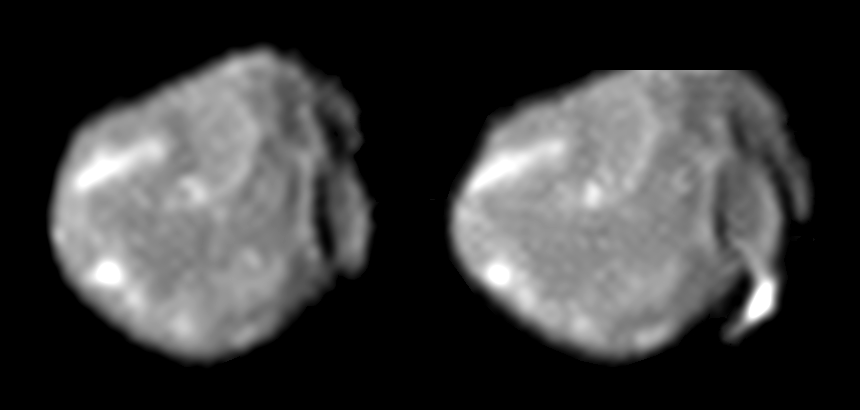




Physical characteristics
All four inner moons are irregularly shaped and have low gravity. Their sizes range from a few to a few hundred kilometres across, so they do not attain spherical shapes. Their surface materials appear to include water ice mixed with darker, rockier material, and their measured densities and shapes suggest porous, fractured interiors rather than compact, monolithic rock. They are synchronously locked to Jupiter, meaning each keeps the same face toward the planet as they orbit.
Members and order
- Metis — the closest known satellite to Jupiter.
- Adrastea — just outside Metis, also small and irregular.
- Amalthea — the largest of the inner moons and occasionally used as the group name.
- Thebe — the outermost of the four, still inside the orbit of the larger Galilean moons.
Orbits, rings and dynamical role
Metis and Adrastea orbit faster than Jupiter rotates, completing a circuit in less than one Jovian day (Jupiter’s rotation period is about ten hours). This rapid motion places them deep within the planet’s gravitational and magnetospheric environment. Impacts by micrometeoroids knock dust from their surfaces; that dust escapes and becomes a principal source of material for Jupiter’s main and gossamer rings. Conversely, the moons also sweep up particles from the rings, so they function as both sources and sinks of ring material. Thebe and Amalthea are associated with the more extended gossamer rings that bear their names and mark their orbital paths.
Origin and discovery
The largest inner moon, Amalthea, was discovered from Earth in the 19th century, while the smallest, closer-in moons and Thebe were identified in the late 20th century largely through spacecraft observations and close flybys. Their irregular shapes and compositions suggest they may be remnants of larger objects that were fragmented or accreted in the neighborhood of Jupiter, rather than bodies formed like the large, differentiated Galilean satellites.
Importance and notable comparisons
These moons are important for understanding ring-moon interactions, surface gardening by micrometeoroid bombardment, and the near-planet environment of Jupiter. Their tight orbits and small sizes make them different from most other moons in the Solar System; for example, the Martian moon Phobos is one of the very few other natural satellites known to orbit its planet in less than the planet’s rotation period. Spacecraft observations continue to refine our knowledge of their shapes, composition and the dynamics of the ring material they interact with.
Questions and answers
Q: What are the inner moons of Jupiter?
A: The inner moons of Jupiter are four small moons that orbit close to Jupiter.
Q: How are the inner moons of Jupiter interconnected with the rings of Jupiter?
A: The inner moons of Jupiter are closely interconnected with the rings of Jupiter and serve as both sources and sinks of the ring's material.
Q: What is the range of the semi-major axes of the inner moons of Jupiter?
A: The range of the semi-major axes of the inner moons of Jupiter is between 128,000 and 222,000 km.
Q: What are the names of the four inner moons of Jupiter, in order from closest to farthest?
A: The members of the group are (in order from closest to farthest): Metis, Adrastea, Amalthea, and Thebe.
Q: Which of the inner moons of Jupiter is the biggest?
A: Amalthea is the biggest of the inner moons of Jupiter.
Q: How long does it take for Metis and Adrastea to orbit Jupiter?
A: Metis and Adrastea each orbit Jupiter in less than one Jovian day (the time it takes for Jupiter to rotate once).
Q: Which other moon is known to orbit its planet in less than the length of that planet's day?
A: Phobos, a moon of Mars, is the only other moon known to orbit its planet in less than the length of that planet's day.
Related articles
Author
AlegsaOnline.com Inner moons of Jupiter Leandro Alegsa
URL: https://en.alegsaonline.com/art/47394
Sources
- astro.umd.edu : Jupiter: The planet, Satellites and Magnetosphere