
Homophone
A homophone is a word that is pronounced the same as another word but differs in meaning and often in spelling. Homophones matter in language, poetry, wordplay, and learning to read and write.
Overview
A homophone is a word that shares pronunciation with one or more other words while having a different meaning; the identical sound may or may not accompany identical spelling. Homophones are widespread in many languages and are a common source of puns, jokes, and spelling errors. They are important in phonology, orthography and language education because they show how spoken forms map imperfectly to written forms.
Image gallery
1 Image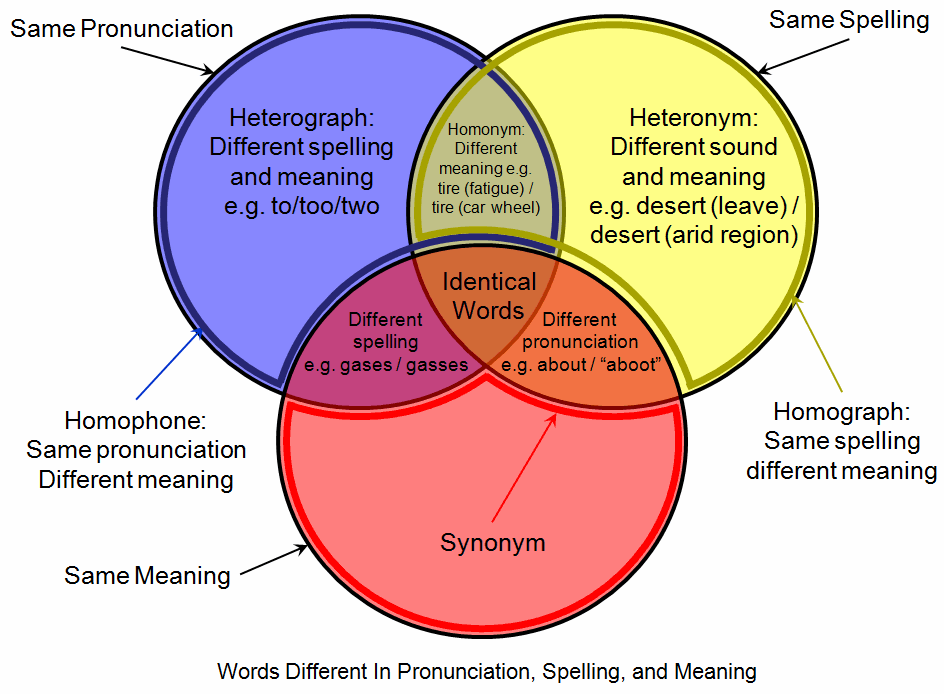
Characteristics
Key features of homophones include pronunciation identity and semantic difference. Spelling can be the same (e.g., words that are both homophones and homographs) or different. Some homophone sets include three or more words that sound alike but diverge in meaning and spelling.
Examples
- to / two / too — function words and numerals
- their / there / they’re — possessive, adverb, contraction
- flower / flour — noun for plant and noun for ground grain
- principal / principle — person or main vs rule or belief
- sea / see — body of water vs verb of perception
Uses and importance
Writers and speakers exploit homophones for puns, double meanings and rhetorical effect. Teachers emphasize homophones when teaching spelling and vocabulary because learners must link sounds to correct written forms. Homophones also pose challenges for speech recognition, text-to-speech and natural language processing systems, which must resolve meaning from context.
History, origin and variation
The term derives from Greek roots meaning "same sound" (homos + phōné). Whether two words are homophones can depend on dialect: pairs like "cot" and "caught" are homophonous in some English accents but distinct in others. Historical sound changes in a language can create new homophones over time.
Distinctions and notable facts
Homophones are often contrasted with homographs (same spelling) and heteronyms (same spelling but different pronunciation and meaning). When a word is both a homophone and a homograph, it is sometimes called a homonym, though definitions of "homonym" vary among linguists and style guides. Understanding these categories helps clarify pronunciation, meaning and orthographic practice.
Related articles
Author
AlegsaOnline.com Homophone Leandro Alegsa
URL: https://en.alegsaonline.com/art/44947