
Amphisbaenia (worm lizards): burrowing squamates
Amphisbaenians, or worm lizards, are a distinct suborder of Squamata adapted for a fossorial (burrowing) lifestyle. This article summarizes their traits, diversity, evolution, ecology, and conservation.
Overview
Amphisbaenia, commonly called worm lizards, are a group of specialized squamate reptiles that spend much of their lives underground. They form a separate suborder within Squamata and show a mosaic of features that connect them to both lizards and snakes, while retaining unique characters of their own. Globally there are roughly 18 genera and about 160 described species distributed across tropical and subtropical regions.
Image gallery
5 Images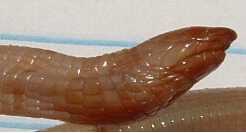


Physical characteristics
Most amphisbaenians are elongated, limbless animals with bodies encircled by ring-like scales called annuli. Their skulls are heavily ossified and differently shaped among species—spade-shaped, shovel-shaped or keeled—reflecting distinct digging styles. Eyes are small and often covered by skin or scales, so vision is limited; the sense of touch and smell are important for finding prey. The tail is short and may be used for autotomy (self-amputation) in some species.
Families and distribution
- Amphisbaenidae — the largest family, widespread in the Americas, Africa and parts of Europe.
- Bipedidae — notable for the Mexican genus with two forelimbs used for digging.
- Rhineuridae — a lineage with a North American presence.
- Trogonophidae — mostly African and Middle Eastern species with distinct skull and jaw adaptations.
These families illustrate a range of morphologies and burrowing behaviors adapted to soils from sand to compact earth.
Behavior, diet and ecology
Amphisbaenians are primarily fossorial predators. Their diet typically includes insects, insect larvae, earthworms and other small invertebrates; larger species may take small vertebrate prey. Many hunt by sensing vibrations and chemical cues. While most time is spent underground, some species emerge on the surface to forage or disperse. Their burrowing contributes to soil turnover and aeration in ecosystems.
Evolution, name and notable facts
The name Amphisbaenia derives from Greek roots meaning "both ways to go," a reference to an old belief that these animals could move equally well forwards and backwards. Molecular and morphological studies place them as a distinct branch within squamates; their exact relationships have been refined as genetic data accumulate. Amphisbaenians have a limited but informative fossil record that helps trace the evolution of burrowing adaptations.
Human interactions and conservation
Many species are little known and can be vulnerable to habitat loss, soil disturbance and introduced predators. Some are protected by conservation measures where they overlap with human development. Basic natural history remains poorly documented for many taxa, so field studies and surveys are important for assessing status and informing conservation. For general taxonomy and species lists consult broader references and databases such as relevant species catalogues and regional faunal accounts.
For further background on squamate relationships and comparative anatomy see resources on Squamata and introductions to lizards and snakes.
Tags
Related articles
Author
AlegsaOnline.com Amphisbaenia (worm lizards): burrowing squamates Leandro Alegsa
URL: https://en.alegsaonline.com/art/3651