
Forehand (tennis stroke)
A detailed overview of the tennis forehand: technique, grips, tactical uses, development, and distinctions from other strokes.
Overview
The forehand is one of the primary groundstrokes in tennis. It is executed by swinging the racquet across the body on the side of the dominant hand and striking the ball at a controlled point in front of the player. For a right-handed player this means the stroke begins to the right, contacts the ball in front of the torso, and finishes toward the left; for left-handed players the directions are reversed. Many players rely on the forehand for consistency, depth and attacking play.
Image gallery
4 Images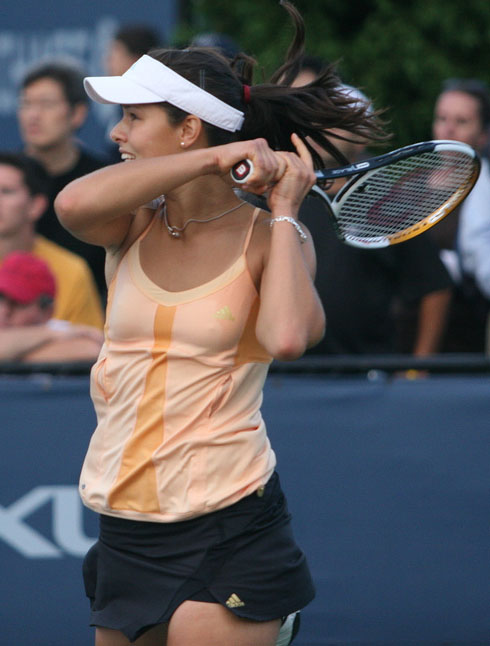


Technique and common variations
Fundamental elements of the forehand include racquet acceleration, timing of contact, and a full follow-through. Variations are defined chiefly by the combination of swing path, contact angle and racquet face at contact, producing different ball behaviors:
- Flat forehand – a more linear swing with minimal spin; used for pace and penetration.
- Topspin forehand – upward brushing of the ball to impart topspin, improving margin over the net and enabling high-bouncing shots.
- Slice forehand – backspin or underspin while moving slightly across the ball; less common but useful for variation and low-bouncing shots.
Grip types and body mechanics
Grip choice strongly affects how the stroke is produced. Typical grips include Eastern, Semi-Western and Western for groundstrokes; each favors a different balance of flat hitting and topspin production. Effective forehands combine several coordinated actions: a split step and quick footwork into the ball, weight transfer from the back to front foot, hip and shoulder rotation to generate torque, contacting the ball slightly in front of the body, and following through to finish the swing. The non-dominant hand helps with unit turn and balance before release.
Tactical use and examples
Players use the forehand in many tactical roles: to start or finish points, to change direction with an inside-out or inside-in forehand, and to apply pressure from the baseline. A heavy topspin forehand can push opponents back, while a flat, deep forehand can produce winners. The shot is also adapted for approach situations and transition to net where shorter, punchier forehands or slice variations are common.
History and development
Early lawn-tennis players often used more neutral or continental grips, but through the 20th century the forehand evolved with equipment and training. Advances in racket technology and string materials, together with coaching emphasis on hip rotation and topspin, led to more powerful and spin-oriented forehands in modern play. The stroke remains an area of continual refinement as players balance power, control and consistency.
Distinctions and notable facts
Compared with the backhand, the forehand is typically the more natural and dominant-side stroke for many players, offering easier access to power and directional control. However, elite players develop both forehand and backhand weapons. For further technical detail and drills, consult additional resources such as specialist coaching guides.
Related articles
Author
AlegsaOnline.com Forehand (tennis stroke) Leandro Alegsa
URL: https://en.alegsaonline.com/art/35602