
Flag of Trinidad and Tobago
National flag adopted at independence in 1962: a red field with a white-fimbriated black diagonal band. Design, symbolism, history, and use explained with notable facts and protocol.
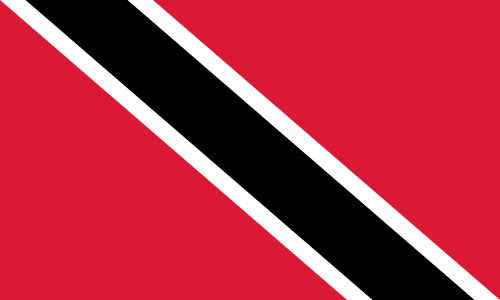
The national flag of Trinidad and Tobago was adopted at independence on 31 August 1962. Its simple, bold composition—a black diagonal band edged in white on a red field—was chosen to be distinctive, symbolic and easy to reproduce. The flag is widely used as the country's primary national emblem on government buildings, ships, ceremonies and international events. Official description and references provide specifications for its colours and proportions.
Image gallery
2 Images

Design and proportions
The flag shows a black band running from the upper hoist-side to the lower fly-side, flanked by narrow white stripes (fimbriation) and set against a dominant red background. The flag's proportions are commonly given as 3:5. Colour placement, widths and angle are defined so that the black band is visually central within its white borders and contrasts strongly with the red field. Design guidance and manufacturing notes are available from government publications and vexillology sources. Specifications describe exact layout and production.
Meaning and symbolism
Colours are traditionally read as symbolic: red represents the vitality of the land and people, their warmth and the energy of the sun; black stands for strength, dedication and the rich soil or heritage of the nation; white signifies the sea that surrounds the islands, purity and equality. These interpretations are general rather than legally binding and are commonly cited in educational and ceremonial contexts. Symbolic notes elaborate on these associations.
History and origin
The flag was selected at the moment of independence and credited to a design process led by local artists and officials. It was intended to move away from colonial ensigns while remaining easily identifiable at sea and on land. Over time the flag has become a strong national identifier, appearing at sporting events, diplomatic missions and cultural celebrations. For historical context and adoption records see archival material.
Use, protocol and variants
- National flag: used by citizens and government; displayed on public buildings and during official ceremonies.
- Ensigns and variations: maritime and governmental ensigns exist for specific uses and may incorporate badges or different proportions.
- Respect and handling: common flag protocol applies—flags should be treated respectfully, not allowed to touch the ground, and displayed according to international practice.
Collecting, studying and reproducing the flag are popular among vexillologists and citizens alike. For further reading and technical diagrams consult official guides and recognised flag studies: further resources.
Author
AlegsaOnline.com Flag of Trinidad and Tobago Leandro Alegsa
URL: https://en.alegsaonline.com/art/34946