
Flag of Mauritania
National flag featuring a green field with a gold star and crescent and red stripes added in 2017; symbols reference Islam and the country's landscape and history.
Overview
The flag of Mauritania is the national banner used to represent the Islamic Republic of Mauritania. Its composition centers on a deep green field punctuated by a gold crescent and star and, since 2017, narrow red stripes at the top and bottom edges. The banner appears on government buildings, at public ceremonies and in international contexts as the primary emblem of state identity.
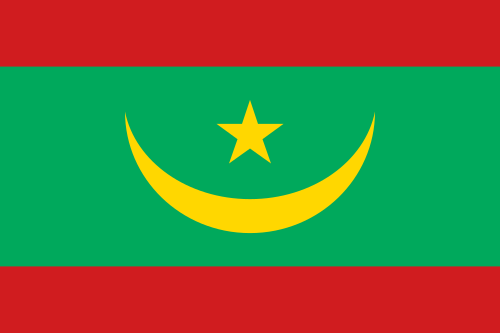
Image gallery
2 Images

Design and symbolism
The flag combines simple geometric and color elements whose meanings are commonly cited in public descriptions. Key components include:
- a green background that echoes the country's Islamic heritage and common symbolism of Islam;
- a gold star and a crescent placed near the center, traditional emblems in many Muslim-majority nations;
- thin red stripes along the top and bottom, introduced recently to commemorate sacrifice and national struggle.
History and development
The basic motif of a green field with a gold crescent and star dates to the country's early years of sovereignty and has long signified religious and cultural affiliation. In 2017 the national flag was modified to add red bands above and below the field; this change was adopted through a constitutional process and drew public attention. The gold color is also commonly associated with the Sahara and the value of mineral and natural resources in the country, a meaning often emphasized in official explanations (gold).
Use and protocol
The flag is used as the principal national symbol at official events, on public buildings and in diplomatic settings. Standard practices include respectful display on flagpoles and observance of common flag etiquette such as not allowing it to touch the ground. Variants for specific services or institutions may exist, but the green field with the central star and crescent and the red stripes is the recognized national design.
Notable facts and distinctions
The combination of a star and crescent on a green field appears in several other national flags, but Mauritania’s addition of narrow horizontal red stripes gives it a distinctive profile. The 2017 alteration prompted discussion inside the country about tradition, symbolism and national memory; responses ranged from broad support to calls for wider consultation. For further reference and official descriptions see related entries and resources (crescent symbolism, recent changes).
Author
AlegsaOnline.com Flag of Mauritania Leandro Alegsa
URL: https://en.alegsaonline.com/art/34849