
Flag of Burkina Faso
National flag of Burkina Faso: two horizontal bands of red and green with a central yellow star. Adopted in 1984 during a revolutionary government; explanation of design, symbolism, history, and use.

The national flag of Burkina Faso consists of two equal horizontal bands of red (top) and green (bottom) with a yellow five-pointed star centered on the field. The current banner was officially adopted on 4 August 1984 and has since served as the primary national emblem flown on government buildings, at official ceremonies and during public holidays.
Image gallery
4 Images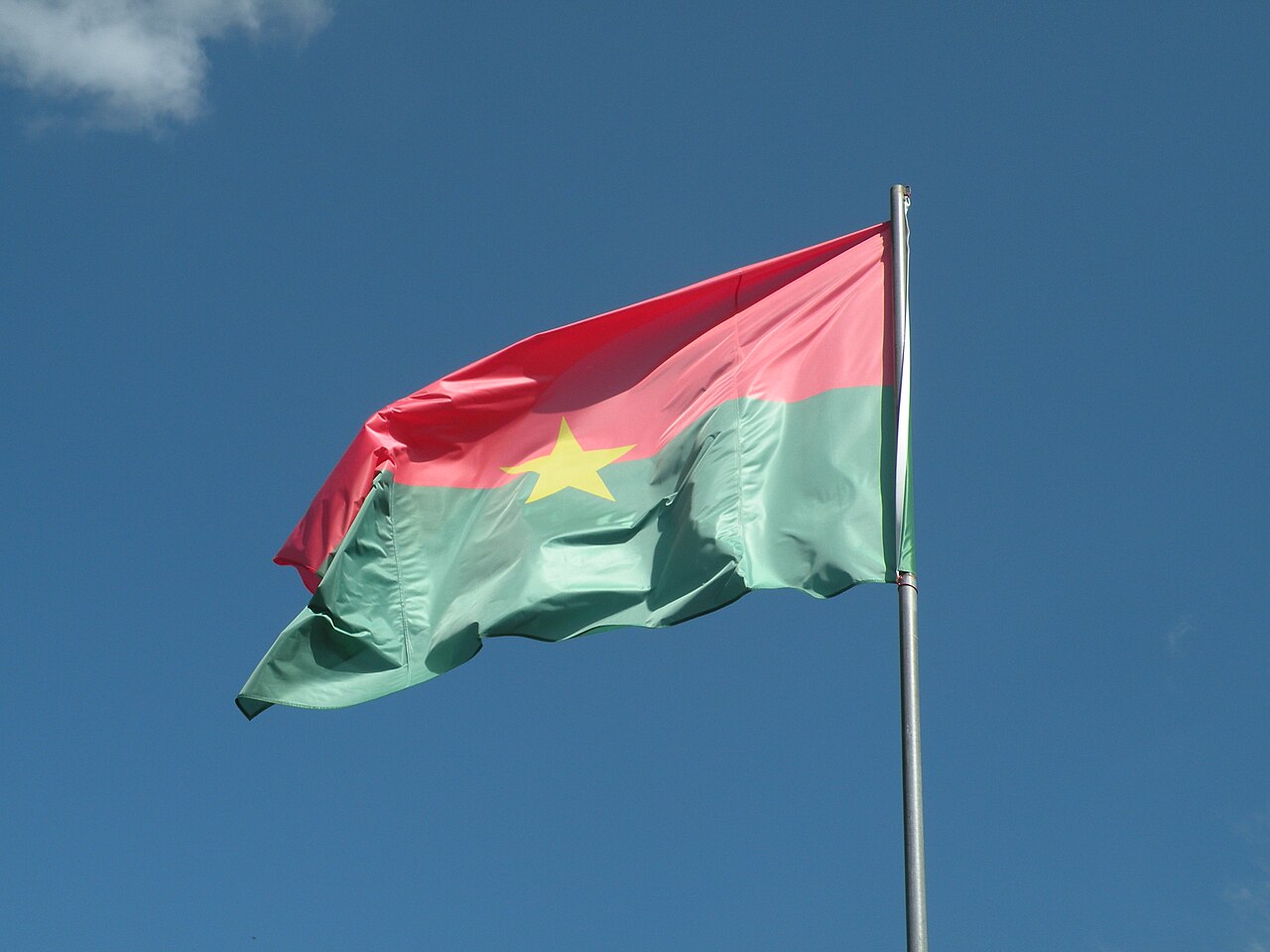


Design and description
The flag is a simple, rectangular panel divided into two horizontal stripes. The upper stripe is red and the lower stripe is green. A small, centrally placed five-pointed star in yellow overlaps both bands. Precise proportions can vary in practice, but the arrangement is consistent: equal horizontal bands with the star at the visual center.
Symbolism
The colors and star carry political and cultural meanings commonly cited in descriptions of the flag. Red is often associated with the struggle for independence and revolutionary change; green is linked to the land, agriculture and hope for prosperity; the yellow star is generally interpreted as a guiding light for the nation and the revolutionary ideals that inspired the flag’s adoption. Different commentators and official sources sometimes emphasize slightly different emphases, but these associations are widely reported.
History and adoption
When the flag was adopted on 4 August 1984, the country was undergoing major political change. The state had been known as Upper Volta until a change of government and a renaming of the country. The new flag replaced the earlier design used by the former state. The adoption took place under the government of Thomas Sankara, and the flag became a visual symbol of the changes his administration promoted.
Uses and protocol
The national flag is used at government offices, military sites, schools and during public events. Protocol for display follows common practices: it is raised in a place of honor alongside other national symbols and treated with respect. Variants for naval or presidential use are not widely reported as standard; the plain national flag is the usual form shown in public contexts.
Notable facts and comparisons
- The color scheme and central star connect the flag to broader Pan-African and revolutionary visual traditions found elsewhere in the region.
- It should not be confused with earlier flags of the same territory; the pre-1984 flags used different arrangements and symbols.
- For more detailed descriptions and official statements, see resources about the Burkina Faso flag, the red band, the green band, the yellow star and related national symbols coverage.
Related articles
Author
AlegsaOnline.com Flag of Burkina Faso Leandro Alegsa
URL: https://en.alegsaonline.com/art/34751