
First Battle of Bull Run (First Battle of Manassas)
The first major land engagement of the American Civil War, fought July 21, 1861, near Manassas, Virginia. A Confederate victory that ended hopes of a short war and reshaped both armies.
Overview. The First Battle of Bull Run, also called the First Battle of Manassas, was fought on July 21, 1861, near a small stream called Bull Run outside Manassas, Virginia. It was the first large-scale land battle of the American Civil War, involving tens of thousands of troops from the Union and the Confederacy. The engagement ended in a Confederate victory and a chaotic Union retreat to Washington, D.C.
Image gallery
10 Images


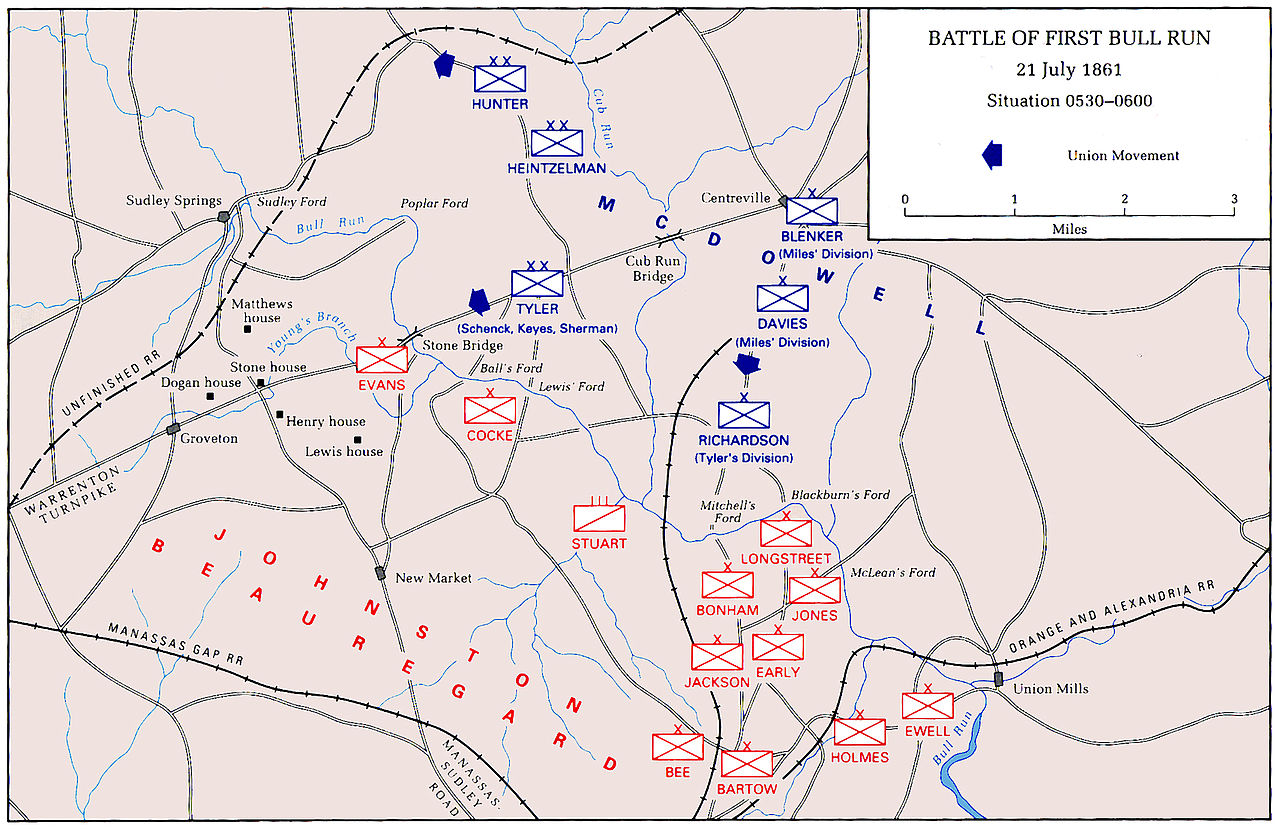


Commanders and forces
Union forces were commanded by Brig. Gen. Irvin McDowell. Confederate forces were led by Brig. Gen. P. G. T. Beauregard, with reinforcements under Gen. Joseph E. Johnston and tactical actions by commanders such as Thomas J. "Stonewall" Jackson. Both sides were composed largely of volunteer regiments with limited combat experience; the armies numbered in the tens of thousands, far larger than the small skirmishes that had preceded the battle.
Course of the battle
The fighting began with Union attacks aimed at turning the Confederate left. Early Union advances met fierce resistance and initial Confederate withdrawals. The arrival of Johnston's reinforcements by rail and the determined stand by Jackson helped reverse Union gains. As Confederate forces pressed their advantage late in the day, Union troops broke and retreated in disorder toward Washington, pursued only intermittently. Civilians from Washington and nearby towns had come to watch the fighting, and many witnessed the sudden collapse of the Union lines.
Consequences and significance
The battle had immediate and long-term effects. It dispelled the widespread expectation that the war would be short and relatively bloodless. Both governments undertook rapid military reorganizations and called for additional troops; the Union appointed new commanders and expanded training and logistics. The Confederacy gained a surge of confidence and public support. Militarily, commanders on both sides learned hard lessons about command, control, reconnaissance, and the challenges of moving and supplying large forces.
Notable facts and distinctions
- The battle is commonly known by both names—Bull Run (after the stream) and Manassas (after the nearby town).
- It was the first major pitched battle of the war and one of the first occasions when rail transport moved reinforcements directly to a battlefield in North America.
- Civilian spectators traveled to watch, a striking and tragic example of how unprepared many were for modern, industrialized warfare.
- The battlefield is preserved today as part of the Manassas National Battlefield Park, where visitors can see the terrain that shaped the fighting.
In sum, the First Battle of Bull Run marked a turning point in public perception and military organization at the start of the Civil War. It transformed expectations, prompted strategic and administrative changes, and signaled that the conflict would be prolonged and costly for both sides.
Related articles
Author
AlegsaOnline.com First Battle of Bull Run (First Battle of Manassas) Leandro Alegsa
URL: https://en.alegsaonline.com/art/34515