
Édouard-Léon Scott de Martinville
French printer and amateur acoustician who invented the phonautograph in the mid-19th century; his phonautograms were later converted to sound and recognized as the earliest known recordings.
Overview
Édouard-Léon Scott de Martinville (1817–1879) was a French printer and bookseller with a strong amateur interest in acoustics. He is best known for inventing the phonautograph, an apparatus that produced the earliest known visual recordings of sound. Scott combined practical experience with printing materials and scientific curiosity about speech and music to produce continuous tracings of airborne vibrations.
Image gallery
3 Images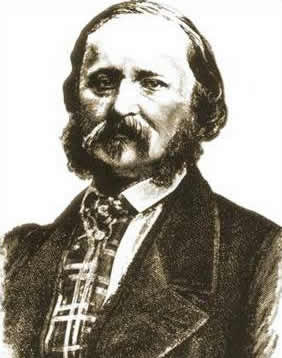


Biography
Born in Paris, Scott worked in the printing trade and published works on shorthand and phonetics. His professional skills gave him access to fine papers, inks and soot treatments used in his experiments. He pursued acoustic investigations alongside his business activities and presented his ideas to learned audiences in mid‑19th century France.
The phonautograph: design and purpose
The phonautograph converted sound waves into visible markings. Sound entered a horn and caused a thin membrane to vibrate; a stylus attached to the membrane inscribed those motions onto a soot‑ or ink‑coated surface such as paper or glass moved by a controller. The resulting "phonautograms" preserved waveform shapes for analysis. Scott patented improvements to the device in the mid‑1850s (1857) and treated the instrument as a tool for scientific study rather than for playback.
Rediscovery and playback
For many decades phonautograms were regarded only as visual records. In the early 21st century, researchers used high‑resolution optical scanning and digital signal processing to convert some 19th‑century phonautograms into audible sound. These reconstructions revealed brief fragments of sung and spoken material dating from around 1860 and are now considered the oldest surviving recordings of the human voice.
Legacy
Scott's work represents an important step in the history of acoustic science and recording technology. Although his device did not reproduce sound, it anticipated later developments by demonstrating that complex acoustic phenomena could be captured and studied. Surviving phonautograms are preserved in archival collections and continue to inform both historical scholarship and the public understanding of early sound recording.
Related articles
Author
AlegsaOnline.com Édouard-Léon Scott de Martinville Leandro Alegsa
URL: https://en.alegsaonline.com/art/30205
Sources
- bbc.co.uk : bbc.co.uk/worldservice/news/2008/03/080328_recording_sl.shtml
- news.bbc.co.uk : news.bbc.co.uk/1/hi/technology/7318180.stm
- firstsounds.org : "FirstSounds.ORG"
- firstsounds.org : firstsounds.org