
Earthquake Performance Simulation
Modeling and testing how buildings and infrastructure respond to seismic shaking using analytical, numerical and experimental methods to assess performance, guide design, retrofit and resilience planning.
Overview
Earthquake performance simulation encompasses the practices used to predict how buildings, components and lifeline systems behave during seismic events. It combines mathematical models, records or synthetic representations of ground motion, and physical testing to estimate demands, possible damage, and whether a structure will meet safety and functionality objectives under defined performance criteria.
Image gallery
4 Images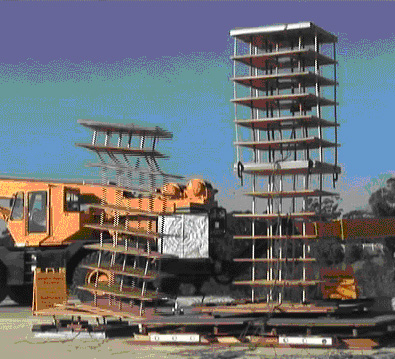


Key components
- Structural models: simplified single-degree-of-freedom systems, multi-degree-of-freedom models, and detailed finite-element representations that include material nonlinearity, connections, and damping.
- Ground motion inputs: recorded accelerograms, scenario-based motions, synthetic time histories and response spectra chosen to reflect local seismic hazard and expected intensity.
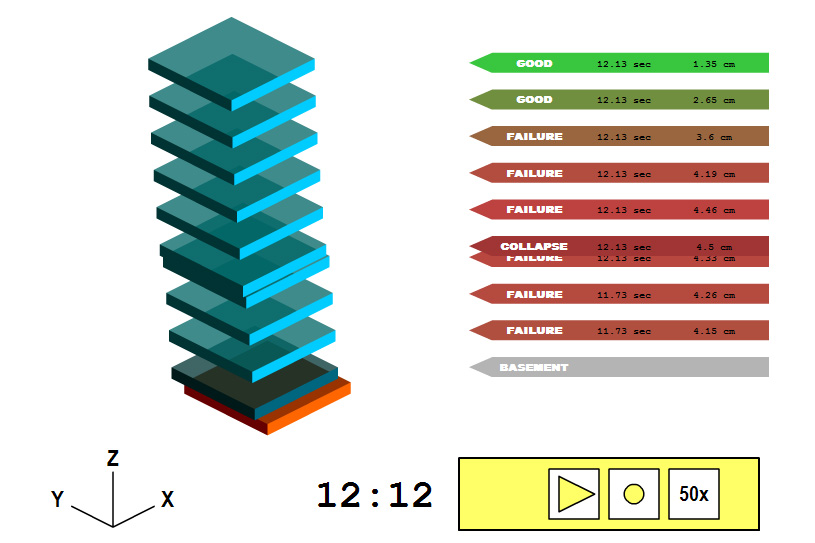
- Analytical methods: linear modal analysis, response spectrum procedures, nonlinear static (pushover) analysis, and nonlinear incremental dynamic and time-history analyses that capture inelastic behavior and cumulative damage.
- Experimental validation: shake-table tests, hybrid simulation and component testing used to calibrate and verify numerical models and to observe failure modes not captured by analysis alone.
Applications
Simulations support seismic design, performance-based engineering, risk assessments, retrofit prioritization, and emergency planning. They help estimate repair costs, downtime and occupant safety for ordinary and critical facilities, and inform decisions about strengthening or replacement of existing structures.
Limitations and best practices
Outcomes depend on model fidelity, the representativeness of ground motions, and uncertainties in material properties and boundary conditions. Best practice includes using multiple ground motions, conducting sensitivity and uncertainty analyses, calibrating models with test data or observed performance, and interpreting results probabilistically rather than as single deterministic predictions.
Trends and future directions
Growing computational power, data from instrumented buildings and networks, and advances in hybrid simulation and machine-learning tools are enhancing realism and speed. Emphasis is increasing on resilience metrics, lifecycle consequences and coupling structural simulation with urban-scale hazard and recovery models to support community-level planning.
Related articles
Author
AlegsaOnline.com Earthquake Performance Simulation Leandro Alegsa
URL: https://en.alegsaonline.com/art/29582
Sources
- commons.wikimedia.org : Earthquake experience vehicles